
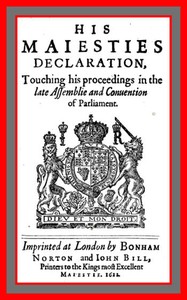
His Maiesties Declaration, touching his Proceedings in the late Assemblie and Conuention of Parliament
Written by King of England James I
Chaptra reads alongside you — AI insights, chapter breakdowns and reader discussions for every book. Join free
About this book
Reading guide
Themes, characters and key ideas in His Maiesties Declaration, touching his Proceedings in the late Assemblie and Conuention of Parliament, written by Chaptra AI.
- about 8 hours
- advanced
- Authoritative
- Defensive
- Historical
James I's "His Maiesties Declaration" serves as a critical historical document articulating the King's perspective on the turbulent dissolution of Parliament in the early 17th century. The declaration meticulously details the grievances and pressures that led to this decision, framing it as a necessary assertion of royal prerogative against perceived parliamentary overreach. It highlights the King's frustration with Parliament's attempts to influence matters traditionally within the monarch's domain, such as foreign policy and royal marriage. Ultimately, the text functions as both a defense of James's actions and a direct appeal to his subjects for loyalty, encapsulating the foundational conflict between monarchical power and parliamentary privilege that shaped British constitutional history.
“Our prerogative is the main point of monarchical power, and shall not be infringed by any subject, whatsoever he be.”
Key themes
- Royal Prerogative vs. Parliamentary Privilege
- This is the central conflict of the declaration. James I staunchly defends the concept of royal prerogative – the exclusive rights and powers of the monarch, derived from divine right and tradition – against what he views as Parliament's unwarranted expansion of its own privileges and attempts to dictate policy.
- Divine Right of Kings
- James I's entire argument for royal prerogative is underpinned by his belief in the divine right of kings – the doctrine that monarchs derive their authority directly from God, not from their subjects or Parliament. This makes any challenge to his authority a challenge to God's will.
- The Nature of Governance and Political Stability
- James presents his actions as essential for maintaining political stability and good governance. He argues that parliamentary overreach leads to disorder and undermines the effective functioning of the state, implying that strong, unquestioned monarchical rule is necessary for societal harmony.
Worth discussing
How does James I justify his assertion of royal prerogative, and what specific arguments does he use?
Chapter-by-chapter breakdowns, character arcs and the full thematic analysis come with a free account.
Discussions
No one has started one yet
Questions this book opens up
No discussions yet
Be the first to start a discussion about this book!
Sign up to start the discussionReviews
No reviews yet
Be the first to review this book!