
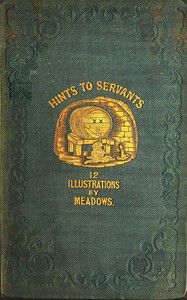
Hints to servants : $b being a poetical and modernised version of Dean Swift's celebrated "Directions to servants;" in which something is added to the original text, but those passages are omitted which cannot with propriety be read aloud in a kitchen
Written by Jonathan Swift,John Jones
Chaptra reads alongside you — AI insights, chapter breakdowns and reader discussions for every book. Join free
About this book
Reading guide
Themes, characters and key ideas in Hints to servants : $b being a poetical and modernised version of Dean Swift's celebrated "Directions to servants;" in which something is added to the original text, but those passages are omitted which cannot with propriety be read aloud in a kitchen, written by Chaptra AI.
- about 8 hours
- intermediate
- humorous
- satirical
- witty
Jonathan Swift's original satirical 'Directions to Servants' receives a whimsical early 19th-century makeover in 'Hints to Servants,' a poetical and modernized adaptation by John Jones (an 'Upper Servant'). This collection of verse offers tongue-in-cheek guidance to various household staff, from the Butler to the Cook, playfully exposing the intricate and often comical dynamics between servants and their employers. Through witty couplets and humorous insights, the book delves into the absurdities of domestic service, highlighting the subtle deceptions and resourceful strategies employed by staff while gently lampooning the social hierarchies of its era. It serves as both an entertaining read and a satirical commentary on the hidden world behind the grand doors of gentry homes.
“When wine runs low, a subtle hand / Can stretch the bounty through the land.”
Key themes
- Social Satire
- The book's overarching theme is the satirical commentary on the rigid social hierarchies and the often-absurd dynamics between masters and their domestic servants in early 19th-century England. It playfully exposes the pretensions of the upper classes and the ingenious, sometimes morally ambiguous, strategies employed by servants to navigate their roles, often to their own benefit.
- Class Dynamics and Hierarchy
- This theme explores the inherent power imbalances and complex relationships within the master-servant structure. The book highlights how servants, despite their subordinate positions, wield subtle forms of power through their intimate knowledge of the household and their masters' habits, often manipulating situations to their advantage within the confines of their roles.
- Deception and Hypocrisy
- A core element of the satire is the prevalence of deception and hypocrisy, both explicit and implicit. Servants are advised on how to appear diligent while being lazy, how to make meager resources seem plentiful, and how to hide their less-than-virtuous practices from their employers. This also implicitly critiques the masters for their often-unrealistic expectations or their willful ignorance.
Worth discussing
How does the poetic format enhance or detract from the satirical message compared to Swift's original prose?
Chapter-by-chapter breakdowns, character arcs and the full thematic analysis come with a free account.
Discussions
No one has started one yet
Questions this book opens up
No discussions yet
Be the first to start a discussion about this book!
Sign up to start the discussionReviews
No reviews yet
Be the first to review this book!