
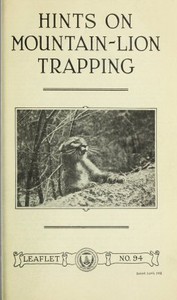
Hints on Mountain-Lion Trapping
Written by Stanley Paul Young
Chaptra reads alongside you — AI insights, chapter breakdowns and reader discussions for every book. Join free
About this book
Reading guide
Themes, characters and key ideas in Hints on Mountain-Lion Trapping, written by Chaptra AI.
- about 6 hours
- intermediate
- informative
- practical
- instructive
Stanley Paul Young's "Hints on Mountain-Lion Trapping" is an early 20th-century scientific guide designed for stockmen and game protectors, offering comprehensive strategies for the control of mountain lion populations. The manual meticulously details the biology and behavior of mountain lions, using this understanding to inform effective trapping techniques. It advocates for the use of trained hounds and specific mechanical traps, explicitly cautioning against poisons, while emphasizing strategic trap placement, lure application, and safety protocols for non-target animals. Ultimately, the book serves as a practical, responsible manual for managing predator-livestock conflicts and protecting game in specific regions, reflecting the prevailing wildlife management philosophies of its era.
“The first step in effective control is understanding the quarry.”
Key themes
- Human-Wildlife Conflict
- This is the foundational theme, exploring the inherent tension and management challenges arising when the natural behavior of a predator (mountain lion) directly impacts human economic interests, particularly livestock and game populations. The book's very existence is a response to this conflict.
- Predator Control and Management
- The core operational theme of the book, detailing the methods, strategies, and rationale behind managing mountain lion populations. It reflects early 20th-century approaches to wildlife management, focusing on targeted reduction or elimination of 'problem' animals.
- Application of Scientific Knowledge to Practical Problems
- The book consistently grounds its practical advice in observations of mountain lion biology, ecology, and behavior. It champions an informed, systematic approach to problem-solving, emphasizing that effective control stems from a deep understanding of the quarry's natural history.
Worth discussing
How have predator control methods and ethics evolved since the early 20th century?
Chapter-by-chapter breakdowns, character arcs and the full thematic analysis come with a free account.
Discussions
No one has started one yet
Questions this book opens up
No discussions yet
Be the first to start a discussion about this book!
Sign up to start the discussionReviews
No reviews yet
Be the first to review this book!