
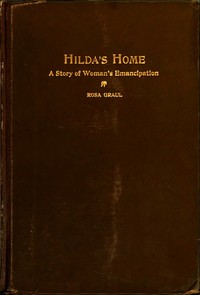
Hilda's Home: A Story of Woman's Emancipation
Written by Rosa Graul
Chaptra reads alongside you — AI insights, chapter breakdowns and reader discussions for every book. Join free
About this book
Reading guide
Themes, characters and key ideas in Hilda's Home: A Story of Woman's Emancipation, written by Chaptra AI.
- about 8 hours
- intermediate
- reflective
- thought-provoking
- romantic
Rosa Graul's late 19th-century novel, "Hilda's Home: A Story of Woman's Emancipation," explores the profound internal and societal struggles faced by women seeking autonomy and fulfillment beyond conventional marriage. The narrative centers on Imelda, a young woman deeply in love with Norman but plagued by fears that marriage will inevitably erode affection and personal freedom, a concern fueled by observations of failed unions and her own troubled past. Through poignant dialogues and Imelda's journey, the book critically examines the institution of marriage, challenges prevailing gender norms, and advocates for a redefined understanding of love, partnership, and individual agency. It serves as a significant historical artifact reflecting the burgeoning feminist thought of its era.
“"Is love truly boundless, or does the cage of matrimony inevitably shrink its wings?"”
Key themes
- Woman's Emancipation and Autonomy
- This is the central theme, exploring the struggle of women in the late 19th century to achieve personal freedom, intellectual independence, and control over their own lives, particularly in contrast to the societal expectation of marriage as their primary role. Imelda's fear of marriage stems directly from her desire to maintain her autonomy, reflecting the broader feminist movement's call for women to be recognized as individuals.
- The Institution of Marriage
- The novel critiques the traditional institution of marriage as it existed in the late 19th century, highlighting its potential to stifle individual identity and affection. It questions whether marriage is inherently conducive to true love and partnership or if it imposes restrictive roles that diminish individuals, particularly women. Imelda's fears serve as a direct challenge to the romanticized view of marriage.
- Love vs. Fear and Past Trauma
- This theme explores the internal conflict between Imelda's genuine love for Norman and her deep-seated fears, which are partly rooted in her 'troubled past.' It delves into how past experiences can shape present perceptions of relationships and commitment, creating psychological barriers to intimacy even when love is present. The novel suggests that true emancipation also involves confronting and overcoming internal fears.
Worth discussing
How does Imelda's fear of marriage reflect the societal constraints placed upon women in the late 19th century?
Chapter-by-chapter breakdowns, character arcs and the full thematic analysis come with a free account.
Discussions
No one has started one yet
Questions this book opens up
No discussions yet
Be the first to start a discussion about this book!
Sign up to start the discussionReviews
No reviews yet
Be the first to review this book!