
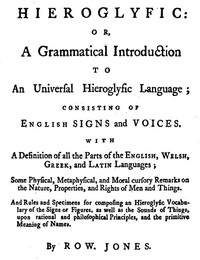
Hieroglyfic: or, a Grammatical Introduction to an Universal Hieroglyfic Language
Written by Rowland Jones
Chaptra reads alongside you — AI insights, chapter breakdowns and reader discussions for every book. Join free
About this book
Reading guide
Themes, characters and key ideas in Hieroglyfic: or, a Grammatical Introduction to an Universal Hieroglyfic Language, written by Chaptra AI.
- about 20 hours
- advanced
- scholarly
- philosophical
- analytical
Rowland Jones's "Hieroglyfic" is a late 17th-century philosophical treatise proposing a universal hieroglyphic language designed to restore clarity to contemporary languages. It posits that human speech is a divine gift, intrinsically linked to nature and the universe, which has since become corrupted. Jones critiques existing linguistic methods, advocating for a return to a 'primitive' understanding of language through a structured examination of its principles, drawing connections between English, Welsh, Greek, and Latin. The work delves into the nature of man, the origins of speech, and the philosophical underpinnings of language, inviting readers into a profound inquiry into the intersections of language, thought, and identity. Through this ambitious project, Jones aims to bridge linguistic divides and re-establish a foundational, universal mode of communication.
“Human speech is a divine gift, entwined with nature and the universe.”
Key themes
- The Quest for a Universal Language
- The central ambition of the book is to delineate a 'universal hieroglyphic language.' This theme explores the historical and philosophical desire to overcome linguistic barriers, not just for practical communication but for deeper conceptual clarity. Jones believes such a language would reconnect 'English signs and voices' with the roots of Welsh, Greek, and Latin, suggesting a deeper, underlying unity of human thought and expression.
- The Divine Origin and Corruption of Language
- Jones posits that human speech is a 'divine gift,' suggesting a sacred or inherent connection between language and the divine order of the universe. He argues that this pristine, original form of language has been 'corrupted' over time, leading to the linguistic chaos and misunderstanding prevalent in his era. This theme underscores a longing for a return to an idealized, pure state of communication.
- Philosophy of Language and Nature of Man
- Jones's inquiry extends beyond mere grammar, delving into the philosophical underpinnings of language and its relationship to human nature. He questions how language shapes thought, how it originates, and what it reveals about the human condition. This theme explores the intricate link between linguistic structures and the very essence of being human.
Worth discussing
What are the implications of viewing language as a 'divine gift' rather than a purely human construct?
Chapter-by-chapter breakdowns, character arcs and the full thematic analysis come with a free account.
Discussions
No one has started one yet
Questions this book opens up
No discussions yet
Be the first to start a discussion about this book!
Sign up to start the discussionReviews
No reviews yet
Be the first to review this book!