
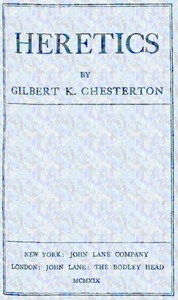
Heretics
Written by G. K. (Gilbert Keith) Chesterton
Chaptra reads alongside you — AI insights, chapter breakdowns and reader discussions for every book. Join free
About this book
Reading guide
Themes, characters and key ideas in Heretics, written by Chaptra AI.
- about 10 hours
- advanced
- Philosophical
- Witty
- Polemical
G. K. Chesterton's "Heretics" is a trenchant philosophical critique penned in the early 20th century, dissecting the intellectual and moral landscape of his era. Chesterton argues that modern society, in its zeal to reject conventional truths, has inverted the traditional meanings of orthodoxy and heresy, often celebrating narrow, self-contradictory views as progress. Through witty and paradoxical essays, he systematically dismantles the philosophies of prominent contemporaries like H.G. Wells, Rudyard Kipling, and George Bernard Shaw, whom he identifies as 'heretics' for their abandonment of fundamental, overarching ideals. The book champions the necessity of a coherent philosophical framework and a return to essential truths, asserting that true freedom lies not in breaking all bounds, but in understanding and embracing foundational principles. Ultimately, "Heretics" serves as a spirited defense of common sense, wonder, and a holistic view of human experience against the fragmented, specialized, and often nihilistic tendencies of modernity.
“A man is more himself, man is more man, when he is the citizen of a city than when he is the citizen of the world.”
Key themes
- The Nature of Orthodoxy and Heresy
- Chesterton redefines these terms: orthodoxy is not rigid dogma but a comprehensive, dynamic truth that embraces paradox and mystery, providing a complete view of reality. Heresy, conversely, is not a deviation from a fixed creed but a narrow, specialized viewpoint that, in its focus on a single aspect, distorts the larger truth and limits human experience.
- The Dangers of Modern Relativism and Specialization
- Chesterton critiques the abandonment of overarching ideals and universal truths in favor of individual preference or specialized knowledge. He argues that this leads to moral and intellectual confusion, a loss of common sense, and a society that cannot agree on fundamental principles, ultimately diminishing human joy and freedom.
- The Importance of Philosophical Foundations
- Chesterton consistently argues that a coherent, broad, and deeply considered worldview is essential for a meaningful life and a stable society. He contends that without fundamental beliefs, individuals and societies lose their direction, purpose, and ability to make sound moral judgments.
Worth discussing
How does Chesterton define 'heresy' and 'orthodoxy' in a way that challenges conventional understanding? Do you agree with his definitions?
Chapter-by-chapter breakdowns, character arcs and the full thematic analysis come with a free account.
Discussions
No one has started one yet
Questions this book opens up
No discussions yet
Be the first to start a discussion about this book!
Sign up to start the discussionReviews
No reviews yet
Be the first to review this book!