
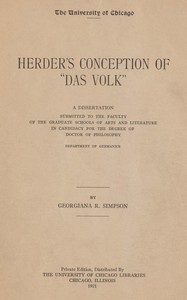
Herder's conception of "das Volk"
Written by Georgiana Rose Simpson
Chaptra reads alongside you — AI insights, chapter breakdowns and reader discussions for every book. Join free
About this book
Reading guide
Themes, characters and key ideas in Herder's conception of "das Volk", written by Chaptra AI.
- about 12 hours
- advanced
- Scholarly
- Analytical
- Philosophical
Georgiana R. Simpson's "Herder's Conception of 'das Volk'" is a pioneering early 20th-century scholarly dissertation meticulously dissecting Johann Gottfried Herder's philosophical and linguistic understanding of the term "Volk." The work embarks on a thorough etymological journey, tracing the word's evolution across Germanic languages from simple demographic descriptor to a profound embodiment of national identity and cultural consciousness. Simpson illuminates how Herder's concept transcends mere population, encapsulating the distinct essence of collective cultural identity while simultaneously acknowledging individual character. Through rigorous analysis, the dissertation explores the intricate interplay between language, culture, and identity as articulated by Herder, establishing its significance in intellectual history.
“Simpson meticulously traces 'Volk' from its Proto-Germanic roots, revealing its transformation from a simple demographic descriptor to a profound identifier of collective spirit.”
Key themes
- The Concept of 'das Volk'
- This is the central theme, exploring the multifaceted meaning and evolution of 'das Volk' as conceptualized by Herder. It delves into how the term moved from a simple descriptor of a crowd or population to an embodiment of collective cultural identity, spirit, and shared consciousness, distinct from mere political governance.
- Language and Cultural Identity
- This theme examines Herder's profound belief that language is not merely a tool but the very foundation and expression of a people's unique cultural identity and thought. Simpson highlights how Herder saw language as intrinsically linked to the spirit and history of a 'Volk'.
- Individuality within Collective Identity
- Simpson explores how Herder's conception of 'das Volk' manages to reconcile the idea of a collective cultural entity with the importance of individual character and development. It's not a monolithic group but a dynamic interplay where individual uniqueness contributes to the richness of the collective.
Worth discussing
How does Simpson's etymological analysis of 'Volk' inform and shape her interpretation of Herder's philosophical concept?
Chapter-by-chapter breakdowns, character arcs and the full thematic analysis come with a free account.
Discussions
No one has started one yet
Questions this book opens up
No discussions yet
Be the first to start a discussion about this book!
Sign up to start the discussionReviews
No reviews yet
Be the first to review this book!