
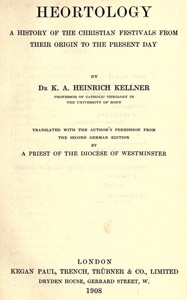
Heortology : $b A history of the Christian festivals from their origin to the present day
Written by K. A. Heinrich (Karl Adam Heinrich) Kellner
Chaptra reads alongside you — AI insights, chapter breakdowns and reader discussions for every book. Join free
About this book
Reading guide
Themes, characters and key ideas in Heortology : $b A history of the Christian festivals from their origin to the present day, written by Chaptra AI.
- about 8 hours
- advanced
- scholarly
- historical
- informative
K. A. Heinrich Kellner's "Heortology" offers a meticulous historical examination of Christian festivals, tracing their origins, evolution, and theological underpinnings from ancient times to the early 20th century. Primarily focusing on the Roman Catholic Church, the book systematically dissects the ecclesiastical calendar, revealing how each festival developed from Jewish traditions and pagan influences into established Christian observances. It emphasizes the profound significance of sacred time in expressing worship and reflecting theological truths. Serving as a foundational resource, Kellner's work aims to provide clergy, theologians, and students of religious studies with a comprehensive understanding of liturgical history and its spiritual implications.
“The rhythm of sacred time is not merely a human construct, but an echo of the divine order, inviting humanity into a perpetual dialogue with the transcendent.”
Key themes
- Sacred Time and Liturgical Practice
- This theme explores the fundamental concept of time being set apart for divine worship and reflection. Kellner meticulously details how Christian festivals transform ordinary days into extraordinary occasions, creating a cyclical rhythm that guides the faithful through the narrative of salvation. It examines the theological rationale behind dedicating specific days to commemorate events in Christ's life, the lives of saints, or core doctrines, emphasizing their role in fostering communal and individual spiritual growth.
- Historical Evolution of Christian Festivals
- Kellner traces the intricate historical development of Christian festivals, demonstrating their dynamic evolution from nascent traditions to codified observances. This theme explores the origins of festivals, often rooted in Jewish practices or adapted from pagan customs, and their subsequent transformation and theological reinterpretation within the Christian context. It highlights the layers of history, cultural assimilation, and theological refinement that have shaped each feast.
- Theological Significance of Festivals
- Beyond mere historical commemoration, this theme delves into the profound theological meaning embedded within each Christian festival. Kellner explores how festivals serve as didactic tools, communicating core doctrines—such as the Incarnation, Resurrection, or the role of the saints—and fostering a deeper spiritual understanding and participation in the mysteries of faith. It emphasizes the spiritual purpose of these observances in shaping Christian belief and piety.
Worth discussing
How does Kellner's analysis of 'sacred time' resonate or conflict with modern secular understandings of time?
Chapter-by-chapter breakdowns, character arcs and the full thematic analysis come with a free account.
Discussions
No one has started one yet
Questions this book opens up
No discussions yet
Be the first to start a discussion about this book!
Sign up to start the discussionReviews
No reviews yet
Be the first to review this book!