
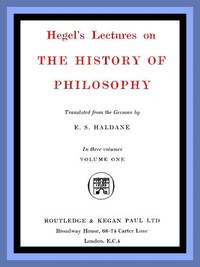
Hegel's Lectures on the History of Philosophy: Volume 1 (of 3)
Written by Georg Wilhelm Friedrich Hegel
Chaptra reads alongside you — AI insights, chapter breakdowns and reader discussions for every book. Join free
About this book
Reading guide
Themes, characters and key ideas in Hegel's Lectures on the History of Philosophy: Volume 1 (of 3), written by Chaptra AI.
- about 40 hours
- advanced
- Academic
- Profound
- Analytical
Hegel's Lectures on the History of Philosophy: Volume 1 (of 3) presents a foundational exploration of the historical development of philosophical thought, framed through Hegel's unique idealist and dialectical lens. This volume introduces his overarching philosophical perspective, emphasizing that philosophy is not a static collection of opinions but a continuous, rational evolution of the Absolute Spirit. Hegel asserts that understanding the history of philosophy is crucial for grasping truth, as each epoch and system contributes to a deeper, more comprehensive understanding. He aims to revitalize the study of philosophy by demonstrating its inherent rationality and interconnectedness across different historical periods, laying the groundwork for his subsequent analysis of specific philosophical systems.
“The history of philosophy is not a haphazard collection of opinions, but a necessary development of Reason.”
Key themes
- The Dialectical Nature of History
- Hegel posits that history, particularly the history of philosophy, does not proceed linearly but through a dialectical process of thesis, antithesis, and synthesis. Each philosophical system represents a partial truth (thesis) that inevitably encounters its limitations or opposition (antithesis), leading to a higher, more comprehensive understanding (synthesis). This process is not one of mere contradiction but of 'sublation' (Aufhebung), where previous stages are both negated and preserved in a new form.
- The Rationality of History and the Absolute Spirit
- A core tenet of Hegel's philosophy is that history is not a chaotic series of events but a rational, purposeful process guided by the 'Absolute Spirit' or 'Reason' towards self-realization. Philosophy, as the conceptual articulation of this Spirit, reveals the inherent rationality and teleology (goal-directedness) of historical development. Each epoch, culture, and philosophical system is a necessary stage in the Spirit's journey to achieve full self-consciousness and freedom.
- The Unity of Thought and Being
- Hegel rejects the traditional Cartesian dualism between subjective thought and objective reality. For him, thought (or Reason) is not merely a reflection of being but is constitutive of it. The Absolute Spirit manifests itself as both objective reality and the subjective consciousness that apprehends it. The history of philosophy thus tracks the progressive reconciliation and recognition of this fundamental unity, moving beyond earlier systems that posited a radical separation.
Worth discussing
How does Hegel's view of the history of philosophy differ from a purely chronological or descriptive approach?
Chapter-by-chapter breakdowns, character arcs and the full thematic analysis come with a free account.
Discussions
No one has started one yet
Questions this book opens up
No discussions yet
Be the first to start a discussion about this book!
Sign up to start the discussionReviews
No reviews yet
Be the first to review this book!