
Chaptra

The AI reading companion for people who take books seriously

AI insights, chapter breakdowns, community discussions — all in one place.

Join free
Book0 • 300+ pages • 5+ hours reading time

Hawkins Electrical Guide v. 05 (of 10): Questions, Answers, & Illustrations, A progressive course of study for engineers, electricians, students and those desiring to acquire a working knowledge of electricity and its applications

4.8/5
220 readers on Chaptra have this book

About this book

"Hawkins Electrical Guide v. 05 (of 10)" by N. Hawkins is a scientific publication written in the early 20th century. This volume is part of a progressive course of study designed for engineers, electricians, and students who wish to grasp working knowledge of electricity and its applications. The guide covers specific topics related to alternating currents, their principles, and uses, making it a valuable educational resource. The opening of the work introduces the concept of alternating currents, outlining their definition and fundamental principles. It explains the behavior of alternating currents compared to direct currents, emphasizing their periodic nature and the importance of their magnetic effects. The text presents advantages and disadvantages of using alternating current, including its efficiency in transmission over long distances and its utility in various electrical applications. Additionally, the first section includes definitions, diagrams, and graphs to illustrate these concepts, setting a technical foundation for further exploration on the subject matter.
Language
English
Publisher
Project Gutenberg
Release date
Unknown
Downloads
207

More by N. (Nehemiah) Hawkins

Browse all books by this author

Explore Electrical engineering Books

Discover more Electrical engineering literature
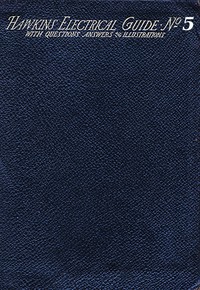
Cover of Hawkins Electrical Guide v. 05 (of 10): Questions, Answers, & Illustrations, A progressive course of study for engineers, electricians, students and those desiring to acquire a working knowledge of electricity and its applications

Click "Read now" to open in our Reader with AI features.

Community Discussions

Join the conversation about this book

Discussions

0 discussions

Join

No discussions yet

Be the first to start a discussion about this book!

Sign up to start the discussion

AI-Powered Insights

A clearer way to understand Hawkins Electrical Guide v. 05 (of 10): Questions, Answers, & Illustrations, A progressive course of study for engineers, electricians, students and those desiring to acquire a working knowledge of electricity and its applications through themes, characters, and key ideas

This reading guide highlights what stands out in Hawkins Electrical Guide v. 05 (of 10): Questions, Answers, & Illustrations, A progressive course of study for engineers, electricians, students and those desiring to acquire a working knowledge of electricity and its applications through 3 core themes, and 3 chapter-level ideas. It is meant to help readers decide whether the book fits their taste and deepen the reading once they begin.

AI Reading GuidePreview

About this book

A quick AI guide to “Hawkins Electrical Guide v. 05 (of 10): Questions, Answers, & Illustrations, A progressive course of study for engineers, electricians, students and those desiring to acquire a working knowledge of electricity and its applications

Get the shape of the book before you commit: what it is about, what mood it carries, and what ideas readers tend to stay with afterward.

~12h readintermediateinstructiveinformativesystematic

What the book is doing

Hawkins Electrical Guide v. 05 is a seminal early 20th-century technical manual, forming part of a ten-volume progressive course on electricity. This specific volume focuses intently on alternating currents (AC), offering a foundational understanding for aspiring engineers, electricians, and students. It systematically introduces AC principles, definitions, and behavior, contrasting them with direct currents (DC), while also detailing the practical applications and advantages of AC, particularly for long-distance power transmission. Rich with diagrams, graphs, and clear explanations, the guide serves as an invaluable historical and educational resource for mastering the complexities of AC electricity.

Key Themes

The Principles of Alternating Current

This is the core subject matter, explored through definitions, comparisons with DC, and explanations of its unique characteristics like periodic nature and magnetic effects. The guide systematically breaks down the theoretical underpinnings of AC.

Practical Applications and Efficiency of AC

The guide emphasizes why AC became the dominant form of electrical power, focusing on its practical utility, especially for long-distance transmission and various industrial applications. It addresses the 'why' behind the 'what'.

A line worth noting
Alternating current is distinguished by its periodic reversal of direction and magnitude, a fundamental difference from direct current.
A good discussion starter

How did the pedagogical approach of 'Questions, Answers, & Illustrations' contribute to the widespread adoption of electrical knowledge in the early 20th century?

Unlock the full reading guide

See chapter-by-chapter takeaways, deeper character arcs, and a fuller literary analysis built around this book.

Unlock full AI analysis for “Hawkins Electrical Guide v. 05 (of 10): Questions, Answers, & Illustrations, A progressive course of study for engineers, electricians, students and those desiring to acquire a working knowledge of electricity and its applications

Chapter breakdowns, character deep-dives, and thematic analysis — all in one place.

Reader Reviews

See what others are saying

Reviews

Overall Rating

4.8
2100 ratings

Based on community ratings

No reviews yet

Be the first to review this book!

Readers Also Enjoyed

Discover more books similar to Hawkins Electrical Guide v. 05 (of 10): Questions, Answers, & Illustrations, A progressive course of study for engineers, electricians, students and those desiring to acquire a working knowledge of electricity and its applications