
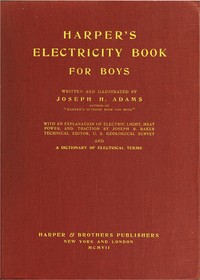
Harper's Electricity Book for Boys
Written by Joseph H. (Joseph Henry) Adams
Chaptra reads alongside you — AI insights, chapter breakdowns and reader discussions for every book. Join free
About this book
Read it with a club
Small groups reading the same books and talking as they go.


News
- 1 member
- 1,813 discussions
- Active 2d ago
Read Harper's Electricity Book for Boys alongside people who are reading it too.
Also here: News Bulletin, Just Joking....
Chaptra Prime — paid clubs, every club feature, and unlimited reading support, for $5 a month or $60 once.
See PrimeReading guide
Themes, characters and key ideas in Harper's Electricity Book for Boys, written by Chaptra AI.
- about 12 hours
- intermediate
- instructive
- inspiring
- practical
Harper's Electricity Book for Boys, authored by Joseph H. Adams in the early 20th century, functions as an engaging and practical manual designed to introduce young boys to the fundamental principles of electricity. The book emphasizes a hands-on learning approach, guiding readers through the construction of simple electrical devices and experiments. It contextualizes electricity within a historical framework, celebrating pioneers and modern advancements, while rigorously stressing the importance of safety and thorough understanding. Ultimately, it aims to cultivate curiosity, foster innovative thinking, and equip its young audience with practical skills and a foundational knowledge of electrical science.
“Electricity, a powerful yet manageable force, is the very pulse of our modern world.”
Key themes
- Practical Application of Science
- The core of the book revolves around the belief that true understanding of scientific principles comes from direct engagement and experimentation. It moves beyond abstract theory to guide readers in constructing functional electrical devices, emphasizing 'learning by doing.'
- Innovation and Creativity
- Beyond mere instruction, the book aims to inspire young readers to think creatively and innovatively. By providing foundational knowledge and tools, it encourages boys to not only replicate existing designs but also to explore, modify, and potentially invent their own applications of electrical principles.
- Safety and Responsibility in Science
- Given the inherent dangers of electricity, the book places significant emphasis on understanding electrical components thoroughly and adhering to strict safety protocols. This instills a sense of responsibility and caution in young experimenters, highlighting that scientific exploration must always be conducted with care and knowledge.
Worth discussing
How does 'Harper's Electricity Book for Boys' reflect the early 20th-century attitudes towards science education for youth?
Chapter-by-chapter breakdowns, character arcs and the full thematic analysis come with a free account.
Discussions
No one has started one yet
Questions this book opens up
No discussions yet
Be the first to start a discussion about this book!
Sign up to start the discussionReviews
No reviews yet
Be the first to review this book!