
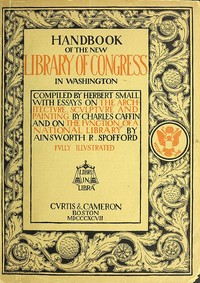
Handbook of the new Library of Congress
Written by Unknown author
Chaptra reads alongside you — AI insights, chapter breakdowns and reader discussions for every book. Join free
About this book
Reading guide
Themes, characters and key ideas in Handbook of the new Library of Congress, written by Chaptra AI.
- about 6 hours
- intermediate
- informative
- historical
- detailed
The 'Handbook of the new Library of Congress' serves as an essential guide and descriptive overview of the newly constructed Library of Congress building, which opened to the public in 1897. It meticulously details the architectural grandeur, artistic embellishments, and functional layout of what was then a state-of-the-art national repository of knowledge. The book aims to inform visitors and scholars alike about the building's various departments, its vast collections, and the intricate system devised for organizing and accessing information. Primarily an informational text, it stands as a historical document reflecting the ambition and pride associated with the establishment of this monumental institution at the turn of the 20th century.
“The Library of Congress stands as a monument to the nation's intellectual aspiration and the enduring power of knowledge.”
Key themes
- The Grandeur of National Institutions
- The handbook implicitly and explicitly celebrates the monumental scale and purpose of the Library of Congress as a symbol of national achievement and prestige. It emphasizes the building's architectural splendor and its role as a repository for the nation's intellectual heritage, positioning it as a cornerstone of American culture and democracy. The detailed descriptions of its construction and artistic adornment underscore the immense investment and pride associated with such a public work.
- Organization and Accessibility of Knowledge
- A core focus of the handbook is the meticulous system developed for organizing and making accessible the Library's immense collections. It details the classification methods, cataloging processes, and the physical layout designed to facilitate efficient retrieval and use of materials. This theme underscores the challenges and innovations in information management at the turn of the 20th century, emphasizing the Library's commitment to democratic access to learning.
- Art and Architecture as Education
- The handbook dedicates significant attention to the artistic and architectural elements of the Library, not merely as decoration, but as integral components of its educational mission. The elaborate murals, sculptures, and symbolic motifs are described as visual narratives designed to inspire, instruct, and reflect the values of knowledge, history, and human achievement. The building itself is presented as a didactic text, embodying the ideals it houses.
Worth discussing
How does the architecture and artistic decoration described in the handbook reflect American national identity and cultural values at the turn of the 20th century?
Chapter-by-chapter breakdowns, character arcs and the full thematic analysis come with a free account.
Discussions
No one has started one yet
Questions this book opens up
No discussions yet
Be the first to start a discussion about this book!
Sign up to start the discussionReviews
No reviews yet
Be the first to review this book!