
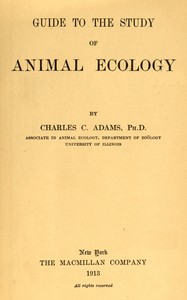
Guide to the study of animal ecology
Written by Charles C. (Charles Christopher) Adams
Chaptra reads alongside you — AI insights, chapter breakdowns and reader discussions for every book. Join free
About this book
Reading guide
Themes, characters and key ideas in Guide to the study of animal ecology, written by Chaptra AI.
- about 12 hours
- beginner
- instructive
- systematic
- analytical
Charles C. Adams's "Guide to the Study of Animal Ecology" is a pioneering early 20th-century scientific publication designed as a practical primer for beginners in animal ecology. The book systematically outlines fundamental methods and concepts, emphasizing the intricate relationships between animals and their environments. Adams, drawing on a decade of research, positions the work not as an exhaustive treatise but as an essential tool for grasping ecological fundamentals and fostering independent scientific inquiry. It covers various ecological components—individual, aggregate, and associational ecology—stressing the importance of rigorous observation, scientific methods, and collaborative research in understanding animal communities.
“not an exhaustive treatise but rather a tool to help students grasp the fundamental concepts and methodologies related to ecological studies.”
Key themes
- Scientific Methodology and Rigor
- The book places a strong emphasis on the proper scientific approach to studying ecology, advocating for systematic observation, data collection, and independent critical thinking. It outlines the necessity of structured methods to ensure accurate and reliable ecological investigations.
- Interconnectedness of Life and Environment
- A core theme is the intricate web of relationships between animals, their physical environments, and other organisms. The guide seeks to illuminate how these interactions shape ecological systems, highlighting the holistic nature of ecological study.
- Foundational Education and Accessibility
- Adams explicitly designs the book as a 'guide for beginners', aiming to make the complex field of ecology accessible and understandable. This theme underscores the author's commitment to education and the systematic transfer of knowledge to new generations of scientists.
Worth discussing
How have the fundamental principles of animal ecology, as outlined by Adams, evolved or remained constant over the past century?
Chapter-by-chapter breakdowns, character arcs and the full thematic analysis come with a free account.
Discussions
No one has started one yet
Questions this book opens up
No discussions yet
Be the first to start a discussion about this book!
Sign up to start the discussionReviews
No reviews yet
Be the first to review this book!