
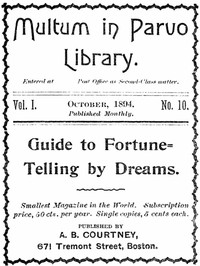
About this book
Read it with a club
Small groups reading the same books and talking as they go.


News
- 4 members
- 1,813 discussions
- Active Sep 11
Read Guide to Fortune-Telling by Dreams alongside people who are reading it too.
Also here: News Bulletin, Just Joking....
Chaptra Prime — paid clubs, every club feature, and unlimited reading support, for $5 a month or $60 once.
See PrimeReading guide
Themes, characters and key ideas in Guide to Fortune-Telling by Dreams, written by Chaptra AI.
- about 5 hours
- beginner
- Mysterious
- Instructive
- Curious
“Guide to Fortune-Telling by Dreams” is a late 19th-century anonymous guidebook dedicated to oneirology, the art of interpreting dreams for future predictions. It systematically categorizes various dream symbols and themes, assigning them specific meanings related to love, business, health, and personal well-being. The guide functions as a practical resource, offering rules and examples to empower readers to decode their nocturnal visions. By connecting the unconscious world of dreams with tangible real-world implications, the book aims to provide individuals with personal guidance and a sense of foresight into their circumstances. It reflects a historical fascination with the mystical and the human desire to understand and influence destiny.
“To dream of Angels signifies health, prosperity, and joy.”
Key themes
- Foresight and Destiny
- The central theme is the belief that dreams offer direct insights into future events, allowing individuals to glimpse their destiny. The guide operates on the premise that one's nocturnal visions are not random but are premonitions of what is to come, whether good or ill. This theme explores humanity's timeless desire to know and potentially alter the future.
- The Unconscious Mind and its Manifestations
- While pre-dating modern psychology, the guide implicitly explores the concept of the unconscious mind by positing that dreams, originating from beyond conscious control, carry profound messages. It suggests that a deeper, hidden part of the self communicates through symbolic language, offering insights inaccessible in waking life. This theme touches upon the mystery of inner workings that influence outer reality.
- Self-Empowerment through Knowledge
- A significant underlying theme is the empowerment of individuals by equipping them with the knowledge to interpret their own dreams. The guide positions itself as a tool for personal agency, allowing readers to gain insight into their circumstances and potentially make informed decisions based on their dream interpretations. This reflects a desire for individuals to take an active role in shaping their lives.
Worth discussing
How does the book reflect the popular beliefs and anxieties of the late 19th century regarding fate and personal control?
Chapter-by-chapter breakdowns, character arcs and the full thematic analysis come with a free account.
Discussions
No one has started one yet
Questions this book opens up
No discussions yet
Be the first to start a discussion about this book!
Sign up to start the discussionReviews
No reviews yet
Be the first to review this book!