
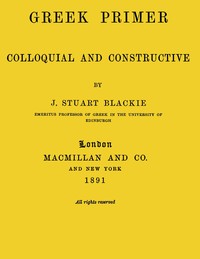
Greek primer, colloquial and constructive
Written by John Stuart Blackie
Chaptra reads alongside you — AI insights, chapter breakdowns and reader discussions for every book. Join free
About this book
Reading guide
Themes, characters and key ideas in Greek primer, colloquial and constructive, written by Chaptra AI.
- about 15 hours
- beginner
- instructive
- reformist
- didactic
John Stuart Blackie's "Greek Primer, Colloquial and Constructive" is a late 19th-century educational text advocating for a radical shift in language instruction. It proposes a "colloquial and constructive" method for learning Greek, emphasizing conversational practice and practical application over rote memorization of grammar rules. Blackie critiques traditional, "tedious" teaching approaches, arguing for a more natural and engaging curriculum that fosters a dynamic interaction between teacher and student. The primer aims to make language acquisition a living, intuitive process, challenging the prevailing academic norms of its time and advocating for practical fluency.
“The opening of the book sets the stage by addressing common complaints about the ineffective and tedious nature of language learning.”
Key themes
- Pedagogical Reform
- The central theme is Blackie's passionate call for a radical overhaul of language teaching methods. He critiques the outdated, ineffective, and tedious nature of traditional grammar-translation approaches, advocating for a more natural, engaging, and practical system. This theme explores the intellectual and practical arguments for shifting educational paradigms.
- Practical Language Acquisition
- This theme focuses on the goal and means of achieving genuine fluency and utility in a new language. Blackie argues against mere theoretical knowledge, emphasizing the importance of practical application, conversation, and contextual understanding for true language mastery. It delves into the cognitive processes involved in natural language learning.
- The Learner-Teacher Relationship
- Blackie highlights the crucial role of interaction and dynamism between the instructor and the student. He moves away from a purely didactic, teacher-as-authority model towards a more collaborative and engaging partnership, where the teacher facilitates a 'living' language experience. This theme explores the interpersonal dynamics essential for effective learning.
Worth discussing
How do Blackie's criticisms of 19th-century language instruction resonate with or differ from contemporary challenges in language education?
Chapter-by-chapter breakdowns, character arcs and the full thematic analysis come with a free account.
Discussions
No one has started one yet
Questions this book opens up
No discussions yet
Be the first to start a discussion about this book!
Sign up to start the discussionReviews
No reviews yet
Be the first to review this book!