
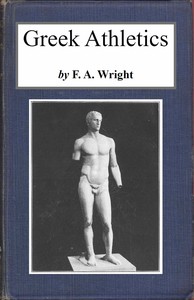
Greek Athletics
Written by F. A. (Frederick Adam) Wright
Chaptra reads alongside you — AI insights, chapter breakdowns and reader discussions for every book. Join free
About this book
Reading guide
Themes, characters and key ideas in Greek Athletics, written by Chaptra AI.
- about 10 hours
- advanced
- analytical
- historical
- critical
F. A. Wright's "Greek Athletics" is an early 20th-century historical examination of the profound role of athletics in ancient Greek society, particularly during the 5th century B.C. The book delves into the traditions, practices, and underlying principles of Greek physical culture, exploring how these shaped societal values concerning fitness, competition, and education. Wright initiates his analysis with a thought-provoking preface, contrasting the perceived physical vigor of ancient Greeks with the contemporary decline in health and athleticism. He meticulously outlines the significance of organized festivals like the Olympics and various forms of physical training, demonstrating the intricate links between athletics, culture, and military preparedness in ancient Greece. Ultimately, the work serves as both a detailed historical account and a critical commentary on the state of modern physical education through the lens of antiquity.
“"To understand the Greek spirit, one must first grasp the pervasive and vital role of the gymnasium, not merely as a place of exercise, but as the crucible of civic virtue and intellectual vigor."”
Key themes
- The Holistic Nature of Greek Athletics
- This theme explores how athletics in ancient Greece were not merely a form of sport or entertainment, but an integral component of education, military training, civic identity, and philosophical development. Wright emphasizes that physical training was inextricably linked to intellectual and moral cultivation, fostering the ideal of a well-rounded citizen (kalokagathia).
- Critique of Modernity and Societal Decline
- A central, provocative theme is Wright's comparison of ancient Greek physical culture with the perceived decline in health, athleticism, and comprehensive human development in his early 20th-century society. He uses the ancient model as a benchmark to highlight what he sees as the shortcomings of contemporary physical education and societal values, suggesting a loss of vigor and holistic well-being.
- The Role of Competition and Festivals
- This theme explores the profound significance of organized athletic festivals, particularly the Olympic Games, within ancient Greek society. Wright details how these events transcended mere sporting contests, serving as crucial cultural, religious, and political gatherings that fostered unity, celebrated human achievement, and provided a platform for individual and city-state glory.
Worth discussing
How does F. A. Wright's early 20th-century perspective influence his interpretation of ancient Greek athletics and his critique of modern society?
Chapter-by-chapter breakdowns, character arcs and the full thematic analysis come with a free account.
Discussions
No one has started one yet
Questions this book opens up
No discussions yet
Be the first to start a discussion about this book!
Sign up to start the discussionReviews
No reviews yet
Be the first to review this book!