
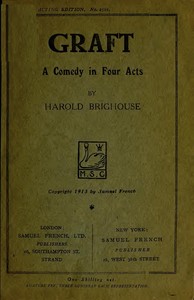
Graft: A Comedy in Four Acts
Written by Harold Brighouse
Chaptra reads alongside you — AI insights, chapter breakdowns and reader discussions for every book. Join free
About this book
Reading guide
Themes, characters and key ideas in Graft: A Comedy in Four Acts, written by Chaptra AI.
- about 3 hours
- intermediate
- humorous
- social commentary
- reflective
Harold Brighouse's early 20th-century play, "Graft: A Comedy in Four Acts," offers a poignant yet humorous look at class disparity and urban struggles through the lens of the Pilling family. Living in a cramped one-room apartment in Carrington, gardener Jim Pilling and his wife Sally yearn for the countryside, while navigating the challenges of raising their son, Dick. The narrative unfolds amidst a local political conflict concerning a proposed recreation ground that threatens the affluent Polygon neighborhood, drawing in characters from various social strata like the ambitious Stephen Verity, a sympathetic curate, and a domineering alderman. This interplay of personal aspirations and community politics, framed within a comedic structure, provides a sharp commentary on social class and the evolving urban landscape.
“"A bit o' green, Sally, just a bit o' green. Is that too much to ask for a man who spends his days making other folks' gardens bloom?"”
Key themes
- Class Disparity and Social Mobility
- The play vividly portrays the stark contrast between the working-class Pilling family, living in cramped conditions, and the affluent residents of the Polygon neighborhood, alongside the ambitious Stephen Verity. It explores not only the economic divide but also the psychological impact of class on aspirations and opportunities, and the challenges of social mobility in early 20th-century Britain.
- Urbanization vs. Nature/Countryside
- A central theme is the tension between rapid urban expansion and the human need for nature and open spaces. Jim Pilling's longing for the countryside is a powerful expression of this, contrasting with the overcrowded, polluted reality of city life. The debate over the recreation ground encapsulates this conflict, representing a battle for green spaces amidst development.
- Political Ethics and Corruption ('Graft')
- The play's title, 'Graft,' explicitly points to this theme. It explores the ethical ambiguities and potential corruption inherent in local politics, particularly as ambitious individuals like Stephen Verity navigate civic projects for personal gain. The play questions whether progress can truly be achieved without moral compromise and examines the self-serving motives behind public service.
Worth discussing
How does the play use comedy to address serious social issues like class disparity and urban poverty?
Chapter-by-chapter breakdowns, character arcs and the full thematic analysis come with a free account.
Discussions
No one has started one yet
Questions this book opens up
No discussions yet
Be the first to start a discussion about this book!
Sign up to start the discussionReviews
No reviews yet
Be the first to review this book!