
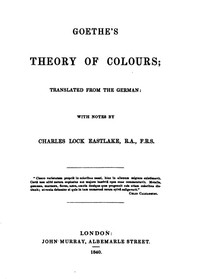
Goethe's Theory of Colours
Written by Johann Wolfgang von Goethe
Chaptra reads alongside you — AI insights, chapter breakdowns and reader discussions for every book. Join free
About this book
Reading guide
Themes, characters and key ideas in Goethe's Theory of Colours, written by Chaptra AI.
- about 12 hours
- advanced
- Philosophical
- Analytical
- Observational
Goethe's "Theory of Colours" is a foundational early 19th-century scientific and philosophical treatise that challenges Newtonian optics by proposing a more subjective, experiential understanding of color. It posits that colors arise from the dynamic interaction of light and darkness, mediated by human perception, rather than being inherent properties of light itself. The work meticulously examines physiological, physical, and chemical aspects of color, integrating scientific observation with aesthetic and philosophical insights. It argues for the significance of human experience and observation in scientific inquiry, profoundly influencing art and philosophy while offering an alternative paradigm to the prevailing scientific reductionism.
“Colours are the deeds of light, deeds and sufferings.”
Key themes
- The Nature of Perception
- Goethe's central theme is that color is not an objective property of light but an active, dynamic interaction between light, darkness, and the human eye. He argues that perception is not passive reception but an active process, heavily influenced by physiological and psychological factors. This challenges the idea of a purely objective reality, suggesting that the observer is integral to the observed phenomenon.
- Subjectivity vs. Objectivity in Science
- This theme explores the tension between Goethe's phenomenological, qualitative, and experiential approach to science and the more reductionist, quantitative, and experimental methodology championed by Newton. Goethe critiques the idea that scientific understanding can be achieved solely through isolating phenomena and mathematical abstraction, arguing instead for a holistic understanding rooted in direct observation and the 'felt' experience of nature.
- The Interplay of Light and Darkness
- Central to Goethe's theory is the idea that color is not solely a product of light, but arises from the dynamic interaction, tension, and mediation between light and darkness. He sees these as fundamental, irreducible forces ('Urphänomene') whose interplay creates the spectrum of colors, rather than darkness being merely the absence of light. This dialectical relationship is a core philosophical tenet of his work.
Worth discussing
How does Goethe's emphasis on observation and subjective experience challenge traditional scientific methodology, particularly that of Newton?
Chapter-by-chapter breakdowns, character arcs and the full thematic analysis come with a free account.
Discussions
No one has started one yet
Questions this book opens up
No discussions yet
Be the first to start a discussion about this book!
Sign up to start the discussionReviews
No reviews yet
Be the first to review this book!