
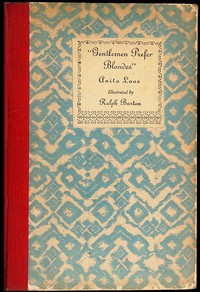
"Gentlemen prefer blondes" : $b The illuminating diary of a professional lady
Written by Anita Loos
Chaptra reads alongside you — AI insights, chapter breakdowns and reader discussions for every book. Join free
About this book
Reading guide
Themes, characters and key ideas in "Gentlemen prefer blondes" : $b The illuminating diary of a professional lady, written by Chaptra AI.
- about 7 hours
- intermediate
- humorous
- witty
- satirical
Anita Loos's "Gentlemen Prefer Blondes" is a sharp, comedic novel told through the diary entries of Lorelei Lee, a charming and strategically naive blonde navigating the social landscape of the 1920s. Lorelei's primary aspiration is to secure material wealth and comfort, which she pursues through a series of relationships with wealthy men, often with the cynical but loyal Dorothy Shaw by her side. The book satirizes societal norms, the superficiality of the Jazz Age, and the performative aspects of femininity, all while offering a surprisingly insightful commentary on female agency and survival in a patriarchal world. Through Lorelei's humorous observations and calculated innocence, Loos crafts an enduring portrait of a woman who understands her value in a world where beauty is currency.
“Kissing your hand may make you feel very very good but a diamond and sapphire bracelet lasts forever.”
Key themes
- Materialism and the Pursuit of Wealth
- This theme is central to the novel, as Lorelei's entire existence revolves around the acquisition of wealth, primarily through diamonds and marriage to rich men. It's portrayed not just as greed, but as a pragmatic survival strategy and a means of achieving security and status in a society where women had limited economic independence. The book satirizes the superficiality of high society where money and possessions often outweigh genuine affection or intellectual pursuits.
- Satire of the Jazz Age and High Society
- The novel brilliantly satirizes the superficiality, excesses, and moral ambiguities of the American Jazz Age and European high society. Through Lorelei's eyes, Loos exposes the hypocrisy, class distinctions, and often vacuous pursuits of the wealthy elite. The 'innocence abroad' trope is subverted, as Lorelei, the seemingly naive American, is far more cunning than her European counterparts or even many of the American men she encounters.
- Female Agency and Empowerment
- Despite Lorelei's seemingly passive and materialistic pursuits, the novel subtly explores a form of female agency within the patriarchal constraints of the 1920s. Lorelei actively engineers her own success and security by strategically using her femininity, charm, and perceived innocence. She is not a victim but a shrewd operator who understands how to manipulate societal expectations to her advantage, thus gaining power in a world where overt female power was often denied.
Worth discussing
To what extent is Lorelei Lee an empowered woman, and to what extent is she a product of patriarchal society?
Chapter-by-chapter breakdowns, character arcs and the full thematic analysis come with a free account.
Discussions
No one has started one yet
Questions this book opens up
No discussions yet
Be the first to start a discussion about this book!
Sign up to start the discussionReviews
No reviews yet
Be the first to review this book!