
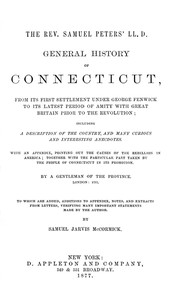
General History of Connecticut, from Its First Settlement Under George Fenwick to its Latest Period of Amity with Great Britain
Written by Samuel Peters
Chaptra reads alongside you — AI insights, chapter breakdowns and reader discussions for every book. Join free
About this book
Reading guide
Themes, characters and key ideas in General History of Connecticut, from Its First Settlement Under George Fenwick to its Latest Period of Amity with Great Britain, written by Chaptra AI.
- about 15 hours
- advanced
- skeptical
- critical
- polemical
Samuel Peters's "General History of Connecticut" is a controversial late 18th-century account that aims to rectify what Peters perceives as an oversight and misrepresentation of Connecticut's colonial history by other historians, particularly those focused on Massachusetts. The book chronicles the state's settlement, development, and interactions with Indigenous peoples, delving into the motivations and actions of early colonizers like George Fenwick and Thomas Peters. While presented as a historical narrative, it is heavily colored by Peters's loyalist biases and personal grievances, leading to a polemical and often embellished portrayal of events. Ultimately, it serves as a critical, albeit unreliable, primary source on the complexities of colonization and the challenges of historical interpretation in early America.
“It is a misfortune to Connecticut, that so few of her sons have been ambitious of transmitting to posterity the history of their ancestors.”
Key themes
- The Nature of Historical Truth and Bias
- Peters explicitly frames his work as a corrective to biased histories, thereby foregrounding the very act of historical interpretation. His own deep-seated loyalist and anti-Puritan biases, however, make the book a prime example of how personal perspective shapes historical narrative, forcing the reader to question the objectivity of all historical accounts.
- Colonization and Its Complexities
- The book chronicles the entire process of colonization in Connecticut, from initial settlement and motivations to the establishment of governance and relationships with Indigenous peoples. Peters's account, while biased, highlights the economic, religious, and political drivers of colonization, as well as the inherent conflicts and injustices that arose.
- Religious and Political Freedom vs. Authoritarianism
- A core tension in Peters's narrative is the clash between the ideals of religious freedom (which often motivated early settlers) and the authoritarian control exerted by the established Puritan government. Peters, as a loyalist and Anglican, critiques the Congregationalist dominance, portraying it as a form of tyranny that stifled individual liberties and led to hypocrisy.
Worth discussing
How does Samuel Peters's personal background and loyalist sympathies influence his historical narrative?
Chapter-by-chapter breakdowns, character arcs and the full thematic analysis come with a free account.
Discussions
No one has started one yet
Questions this book opens up
No discussions yet
Be the first to start a discussion about this book!
Sign up to start the discussionReviews
No reviews yet
Be the first to review this book!