
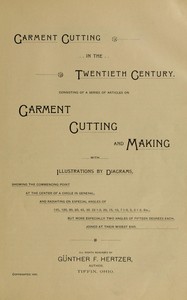
Garment cutting in the twentieth century : $b Consisting of a series of articles on garment cutting and making
Written by Günther F. Hertzer
Chaptra reads alongside you — AI insights, chapter breakdowns and reader discussions for every book. Join free
About this book
Reading guide
Themes, characters and key ideas in Garment cutting in the twentieth century : $b Consisting of a series of articles on garment cutting and making, written by Chaptra AI.
- about 40 hours
- advanced
- instructive
- meticulous
- practical
Günther F. Hertzer's "Garment Cutting in the Twentieth Century" is a foundational instructional treatise on the intricate art of tailoring, specifically focusing on the principles and methodologies of garment cutting. Likely published in the late 19th or early 20th century, this work serves as an indispensable guide for aspiring and established tailors, providing detailed techniques for achieving well-fitted garments. Hertzer, drawing from decades of practical experience, emphasizes the timeless nature of fundamental cutting principles despite evolving styles. The book systematically breaks down complex processes, utilizing diagrams and clear explanations to demystify the craft and empower readers to create custom, comfortable, and aesthetically pleasing clothing.
“While styles may change, the foundational principles of good garment cutting remain constant.”
Key themes
- The Enduring Principles of Garment Cutting
- This is the central theme, articulated explicitly by Hertzer in the preface. It posits that despite changing fashion trends, the underlying geometric, anatomical, and methodological principles of creating well-fitted garments are timeless and universal. The book aims to uncover and teach these immutable fundamentals, providing a stable foundation for any tailor.
- Precision and Fit as the Pinnacle of Tailoring
- The book heavily emphasizes the critical role of accuracy in measurements, angles, and cutting techniques to achieve garments that are both comfortable and perfectly fitted. Hertzer views precision not just as a technical requirement but as the ultimate goal and hallmark of superior tailoring, ensuring client satisfaction and garment longevity.
- The Transfer of Experiential Knowledge
- Hertzer explicitly states his intention to share knowledge 'gleaned from decades of experience.' This theme highlights the value of empirical learning and the importance of passing down practical skills and insights accumulated over a long career. It speaks to the mentorship aspect inherent in traditional crafts.
Worth discussing
How do the 'foundational principles' of garment cutting discussed by Hertzer remain relevant in contemporary fashion design and bespoke tailoring?
Chapter-by-chapter breakdowns, character arcs and the full thematic analysis come with a free account.
Discussions
No one has started one yet
Questions this book opens up
No discussions yet
Be the first to start a discussion about this book!
Sign up to start the discussionReviews
No reviews yet
Be the first to review this book!