
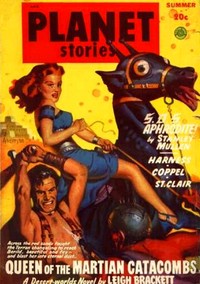
Garden of Evil
Written by Margaret St. Clair
Chaptra reads alongside you — AI insights, chapter breakdowns and reader discussions for every book. Join free
About this book
Reading guide
Themes, characters and key ideas in Garden of Evil, written by Chaptra AI.
- about 8 hours
- intermediate
- dark
- mysterious
- psychological
Margaret St. Clair's "Garden of Evil" is a mid-20th century science fiction novel set on the enigmatic alien planet Fyhon, where themes of addiction, survival, and cultural clash intertwine. It follows Ericson, an ethnographer recovering from a debilitating drug addiction, as he is guided by the native Mnathl into Fyhon's uncharted wilds. Drawn by the land's beauty and the allure of the fabled city of Dridihad, Ericson's journey morphs into a perilous entanglement with the city's inhabitants, the Deidrithes. The narrative culminates in a shocking revelation, shattering Ericson's romanticized perceptions and exposing a dark, horrifying reality beneath the surface of his exploration, forcing a re-evaluation of human desires and the true nature of discovery.
“"Fyhon had a way of whispering promises, sweet as byhror, that led one deeper into its beautiful, terrible heart."”
Key themes
- Clash of Cultures and Colonialism
- As an ethnographer, Ericson embodies the Western 'discoverer' archetype. The novel critiques the colonial gaze and the hubris of assuming one can simply 'understand' or 'document' an alien culture without inherent biases or ethical implications. It highlights the dangers of cultural relativism when faced with truly alien morality and the potential for exploitation, both of the 'other' and of the 'discoverer.'
- Addiction and Recovery
- The novel directly addresses Ericson's struggle with 'byhror' addiction, using his physical and psychological vulnerability to explore how past dependencies can leave one susceptible to new, more insidious forms of entrapment. It examines the process of recovery not as a linear path to freedom, but as a journey fraught with the danger of replacing one addiction (to a substance) with another (to discovery, exoticism, or a false ideal).
- Perception vs. Reality / Deception
- A central theme, the novel meticulously builds a world where appearances are deeply misleading. Ericson's initial impressions of Fyhon as beautiful and its inhabitants as benign are systematically dismantled, revealing a sinister underlying reality. This explores how human desires and preconceived notions can blind one to truth, and how deception can be woven into the fabric of an alien society.
Worth discussing
How does Ericson's addiction to 'byhror' parallel or inform his addiction to the idea of discovery and the exotic beauty of Fyhon?
Chapter-by-chapter breakdowns, character arcs and the full thematic analysis come with a free account.
Discussions
No one has started one yet
Questions this book opens up
No discussions yet
Be the first to start a discussion about this book!
Sign up to start the discussionReviews
No reviews yet
Be the first to review this book!