
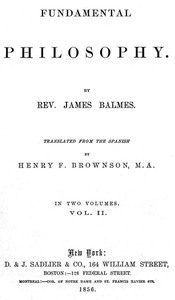
Fundamental Philosophy, Vol. 2 (of 2)
Written by Jaime Luciano Balmes
Chaptra reads alongside you — AI insights, chapter breakdowns and reader discussions for every book. Join free
About this book
Reading guide
Themes, characters and key ideas in Fundamental Philosophy, Vol. 2 (of 2), written by Chaptra AI.
- about 25 hours
- advanced
- academic
- rigorous
- analytical
Jaime Luciano Balmes's "Fundamental Philosophy, Vol. 2 (of 2)" is a profound 19th-century philosophical treatise that delves into the intricate nature of knowledge, ideas, and intellectual processes. Building upon foundational principles, Balmes rigorously critiques prevailing philosophical systems, particularly those of Condillac and Kant, regarding the relationship between sensation, intuition, and reasoning. He meticulously examines the transition from sensory experience to abstract ideas, asserting that while sensations are vital, they are insufficient to explain the full spectrum of human cognition. The work champions the necessity of recognizing a distinct intellectual faculty that transcends mere sensory input, thus offering a sophisticated argument for a more comprehensive understanding of knowledge.
“Sensation, while foundational, cannot alone ascend to the realm of pure ideas; a distinct intellectual faculty is indispensable for true understanding.”
Key themes
- The Nature of Knowledge (Epistemology)
- This is the overarching theme, exploring how humans acquire, validate, and structure knowledge. Balmes systematically investigates the origins of ideas, the reliability of sensory data, and the role of intellectual faculties in forming understanding. He seeks to establish a robust foundation for philosophical inquiry.
- Relationship between Sensation and Intellection
- A core theme that interrogates how sensory experiences (sensation) interact with and contribute to, or are distinct from, higher-order intellectual processes (intellection or reasoning). Balmes argues for a clear distinction and the necessity of both, with intellection transcending sensation.
- Critique of Empiricism/Sensationalism
- Balmes dedicates significant effort to challenging philosophical systems, particularly Condillac's, that reduce all knowledge and intellectual activity to sensory experience. He highlights the limitations of such purely empirical views in explaining abstract ideas, universal truths, and complex reasoning.
Worth discussing
To what extent do sensations truly form the basis of all our knowledge, as Balmes critiques in Condillac's philosophy?
Chapter-by-chapter breakdowns, character arcs and the full thematic analysis come with a free account.
Discussions
No one has started one yet
Questions this book opens up
No discussions yet
Be the first to start a discussion about this book!
Sign up to start the discussionReviews
No reviews yet
Be the first to review this book!