
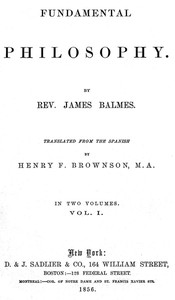
Fundamental Philosophy, Vol. 1 (of 2)
Written by Jaime Luciano Balmes
Chaptra reads alongside you — AI insights, chapter breakdowns and reader discussions for every book. Join free
About this book
Read it with a club
Chaptra's ideas and essays clubs — small groups reading the same books and talking as they go.


Books That Changed My Mind
Ideas and essays
- 5 members
- 4 discussions
- Active Sep 11
Not books you enjoyed. Books that moved you off a position you'd genuinely held for years. This is a Chaptra house club — set up and moderated by us to get the conversation going. Open to everyone; jump in anywhere.
Read Fundamental Philosophy, Vol. 1 (of 2) alongside people who are reading it too.
Chaptra Prime — paid clubs, every club feature, and unlimited reading support, for $5 a month or $60 once.
See PrimeReading guide
Themes, characters and key ideas in Fundamental Philosophy, Vol. 1 (of 2), written by Chaptra AI.
- about 12 hours
- advanced
- thought-provoking
- analytical
- rigorous
Jaime Luciano Balmes's "Fundamental Philosophy, Vol. 1" is a mid-19th-century philosophical treatise that meticulously explores the foundational questions of epistemology, primarily focusing on the nature and necessity of certainty. Balmes argues that an inherent human capacity for certainty is the indispensable prerequisite for any meaningful philosophical inquiry or scientific endeavor, directly refuting historical skeptical positions. He delves into the interplay of sensation and perception, carefully distinguishing between immediate sensory experience and the deeper, more comprehensive understanding required for philosophical knowledge, articulating the difference between real and ideal truths. This initial volume establishes a critical framework for comprehending human cognition and its limitations, laying the groundwork for further explorations into transcendental science and the relationship between consciousness and objective reality.
“The acknowledgment of our inherent capacity for certainty is not merely a preliminary step but the very cornerstone upon which all sound philosophy must be built.”
Key themes
- The Nature and Necessity of Certainty
- This is the central theme of the volume. Balmes argues that certainty is not merely desirable but an inherent, indispensable faculty of the human mind and the absolute prerequisite for any meaningful philosophical or scientific inquiry. He posits that without an acknowledgment of our capacity for certainty, all knowledge claims collapse.
- Critique of Skepticism
- Balmes engages directly with historical and conceptual forms of skepticism, from ancient Pyrrhonism to more modern doubts, systematically dissecting and refuting their claims. He argues that radical skepticism is not only intellectually self-contradictory but also incompatible with the practical demands of human life.
- The Role of Sensation and Perception in Knowledge
- Balmes explores the contribution of sensory experience to human knowledge, acknowledging its immediacy and importance while also delineating its limits. He argues that sensation provides data but does not, by itself, constitute comprehensive philosophical knowledge.
Worth discussing
Balmes argues that certainty is a prerequisite for philosophy. How does this compare to contemporary philosophical approaches that embrace ambiguity or radical doubt?
Chapter-by-chapter breakdowns, character arcs and the full thematic analysis come with a free account.
Discussions
No one has started one yet
Questions this book opens up
No discussions yet
Be the first to start a discussion about this book!
Sign up to start the discussionReviews
No reviews yet
Be the first to review this book!