
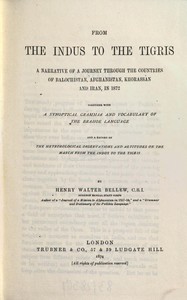
From the Indus to the Tigris : $b A narrative of a journey through the countries of Balochistan, Afghanistan, Khorassan and Iran, in 1872, together with a synoptical grammar and vocabulary of the Brahoe language, and a record of the meteorological observations and altitudes on the march from the Indus to the Tigris
Written by H. W. (Henry Walter) Bellew
Chaptra reads alongside you — AI insights, chapter breakdowns and reader discussions for every book. Join free
About this book
Reading guide
Themes, characters and key ideas in From the Indus to the Tigris : $b A narrative of a journey through the countries of Balochistan, Afghanistan, Khorassan and Iran, in 1872, together with a synoptical grammar and vocabulary of the Brahoe language, and a record of the meteorological observations and altitudes on the march from the Indus to the Tigris, written by Chaptra AI.
- about 8 hours
- advanced
- informative
- observant
- analytical
Henry Walter Bellew's "From the Indus to the Tigris" chronicles a pivotal 1872 journey through Balochistan, Afghanistan, Khorassan, and Iran, offering a unique blend of personal travelogue and geopolitical analysis. The narrative meticulously details Bellew's experiences and observations of the diverse landscapes, cultures, and societies encountered across these strategically vital regions. Beyond a mere travel account, the work delves into the complex political dynamics of the late 19th century, particularly the burgeoning 'Great Game' between the British and Russian empires and its implications for British India. Supplementing the expedition's narrative are significant academic contributions, including a synoptical grammar and vocabulary of the Brahoe language, alongside comprehensive meteorological data and altitudinal measurements. This multifaceted text thus serves as an invaluable historical document, a linguistic resource, and a testament to 19th-century exploration and imperial strategy.
“The shadow of the Russian bear stretches long across the plains of Central Asia, a challenge to the very foundations of our Indian Empire.”
Key themes
- Imperialism and Geopolitics (The Great Game)
- The central underlying theme, exploring the rivalry between the British and Russian Empires for dominance in Central Asia. Bellew consistently frames his observations through the lens of British strategic interests, analyzing the political stability, military potential, and allegiances of the various regions and tribes. The journey itself is an act of intelligence gathering and assertion of influence.
- Exploration and Discovery
- The physical act of journeying through unknown or poorly documented territories is a core theme. Bellew's expedition embodies the spirit of 19th-century exploration, driven by a desire to map, observe, and understand the world, often for scientific and strategic purposes. It highlights the challenges, endurance, and meticulous documentation required for such endeavors.
- The Pursuit of Knowledge (Scientific and Linguistic)
- Beyond the political and explorative aspects, the book emphasizes a commitment to scientific and linguistic inquiry. Bellew's meticulous recording of meteorological data, altitudes, and his detailed study of the Brahoe language underscore a broader 19th-century European drive to systematically catalog and understand the natural world and human cultures. This reflects a belief in the power of empirical observation and systematic study.
Worth discussing
How does Bellew's narrative reflect the political anxieties and imperial ambitions of 19th-century Britain regarding Central Asia?
Chapter-by-chapter breakdowns, character arcs and the full thematic analysis come with a free account.
Discussions
No one has started one yet
Questions this book opens up
No discussions yet
Be the first to start a discussion about this book!
Sign up to start the discussionReviews
No reviews yet
Be the first to review this book!