
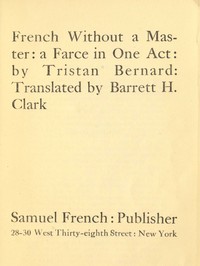
French without a master : $b A farce in one act
Written by Tristan Bernard
Chaptra reads alongside you — AI insights, chapter breakdowns and reader discussions for every book. Join free
About this book
Reading guide
Themes, characters and key ideas in French without a master : $b A farce in one act, written by Chaptra AI.
- about 8 hours
- beginner
- humorous
- lighthearted
- chaotic
Tristan Bernard's "French without a Master" is a delightful one-act farce from the early 20th century, expertly blending humor with astute social commentary. The play masterfully exploits the comedic potential of language barriers and cultural misunderstandings within the bustling setting of a London hotel. It follows the chaotic unraveling of an elopement between Gerald Forsyth and Séraphine Chanoine-Malherbe, intensified by the unexpected arrival of Séraphine's father. The situation spirals into hilarious pandemonium, largely due to the incompetence of Percy, a self-proclaimed interpreter who speaks no French, leading to a series of mistaken identities and farcical exchanges. Ultimately, Bernard's work serves as a witty exploration of human communication, or lack thereof, and the inherent absurdity found in cross-cultural interactions.
“"But I assure you, Monsieur, I speak French... a little. Just enough to be dangerous, it seems!"”
Key themes
- Miscommunication and Language Barriers
- This is the central theme of the play, explored through the hilarious and chaotic consequences of Percy's inability to translate between French and English. It highlights how easily meaning can be lost or distorted, leading to absurd situations and profound frustration. The play uses these barriers not just for humor but to comment on the inherent difficulties in human communication, even when intentions are clear.
- The Absurdity of Human Folly
- The play revels in the inherent absurdity of human behavior, particularly when individuals are driven by strong emotions (like love or paternal anger) and hindered by external factors (like a language barrier). The characters' earnest attempts to navigate or control the situation only lead to greater chaos, underscoring the often-irrational nature of human interactions and the unpredictable outcomes of life.
- Social Conventions vs. Individual Desire
- Underpinning the comedic chaos is the conflict between Séraphine and Gerald's desire to marry (representing individual will and romantic love) and Monsieur Chanoine-Malherbe's attempts to prevent it (representing parental authority and social convention). The elopement itself is a challenge to established norms, and the play's resolution, while farcical, often addresses the eventual triumph or compromise of these opposing forces.
Worth discussing
How does the play use language barriers to create humor, and what does this suggest about communication in general?
Chapter-by-chapter breakdowns, character arcs and the full thematic analysis come with a free account.
Discussions
No one has started one yet
Questions this book opens up
No discussions yet
Be the first to start a discussion about this book!
Sign up to start the discussionReviews
No reviews yet
Be the first to review this book!