
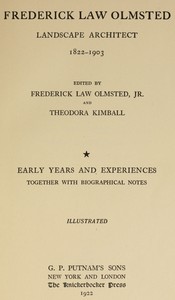
Frederick Law Olmsted : $b Landscape architect. Vol. 1, Early years and experiences, together with biographical notes.
Written by Frederick Law Olmsted
Chaptra reads alongside you — AI insights, chapter breakdowns and reader discussions for every book. Join free
About this book
Reading guide
Themes, characters and key ideas in Frederick Law Olmsted : $b Landscape architect. Vol. 1, Early years and experiences, together with biographical notes., written by Chaptra AI.
- about 12 hours
- advanced
- Informative
- Scholarly
- Historical
This foundational volume, "Frederick Law Olmsted: Landscape Architect, Vol. 1, Early Years and Experiences," meticulously chronicles the formative period of Frederick Law Olmsted, a pivotal figure in landscape architecture. Published in the early 20th century, it presents a curated collection of his professional papers, letters, and biographical notes, illuminating the influences and early projects that shaped his illustrious career. The book delves into Olmsted's intellectual development, his commitment to public welfare through design, and his crucial collaborations, such as with Calvert Vaux on Central Park. It emphasizes Olmsted's dedication to documenting his work, aiming to elevate landscape architecture as a recognized and respected profession. Ultimately, this volume serves as an indispensable resource, setting the stage for understanding Olmsted's enduring legacy and his innovative methodologies.
“"The main object of the Park is to provide a ground where the great body of the people of the city can find the greatest measure of refreshment and recreation."”
Key themes
- The Genesis of Landscape Architecture
- This theme explores how Olmsted, through his diverse experiences and intellectual synthesis, pioneered and formalized the discipline of landscape architecture. The book details his efforts to define its principles, methodologies, and professional standards, effectively creating a new field dedicated to the design of human environments.
- Public Good and Civic Responsibility
- A central tenet of Olmsted's philosophy, this theme emphasizes his unwavering belief that well-designed public spaces are essential for the health, well-being, and social cohesion of urban populations. The book showcases his commitment to creating democratic spaces accessible to all citizens.
- Visionary Leadership and Collaboration
- This theme highlights Olmsted's ability to conceptualize and advocate for large-scale, long-term projects that often faced political and logistical challenges. It also explores the critical role of collaboration, particularly his partnership with Calvert Vaux, in bringing these complex visions to fruition.
Worth discussing
How does Olmsted's early life and diverse experiences contribute to his unique vision for landscape architecture?
Chapter-by-chapter breakdowns, character arcs and the full thematic analysis come with a free account.
Discussions
No one has started one yet
Questions this book opens up
No discussions yet
Be the first to start a discussion about this book!
Sign up to start the discussionReviews
No reviews yet
Be the first to review this book!