
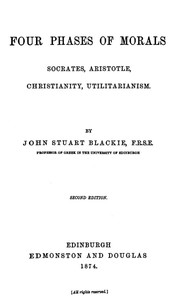
Four Phases of Morals: Socrates, Aristotle, Christianity, Utilitarianism
Written by John Stuart Blackie
Not rated yet — tap a star to review it
Chaptra reads alongside you — AI insights, chapter breakdowns and reader discussions for every book. Join free
About this book
"Four Phases of Morals: Socrates, Aristotle, Christianity, Utilitarianism" by John Stuart Blackie is an ethical discourse that was written in the late 19th century. This work presents a detailed exploration of moral philosophy through the historical context of four important figures and schools of thought: Socrates, Aristotle, Christianity, and utilitarianism. The book aims to highlight the evolution of moral concepts and their relevance to human existence, emphasizing the integral nature of ethical reflection in societal progress. The opening of the discourse sets the stage by acknowledging the author's background as a professor of Greek at the University of Edinburgh, indicating that the content draws heavily from scholarly research and historical analysis. It begins with a tribute to Socrates, presenting him as the cornerstone of moral philosophy, and outlines the aim to illuminate his contributions, particularly through reliable contemporary sources like Xenophon and Plato. Blackie introduces Socratic teachings on the nature of virtue, the importance of moral reasoning, and the interplay between individual happiness and societal good, laying a foundational understanding that will guide the subsequent examination of Aristotle, Christianity, and utilitarian thought. This scholarly introduction invites readers to explore ethical theories that shaped Western civilization and their practical implications for life.
Reading guide
Themes, characters and key ideas in Four Phases of Morals: Socrates, Aristotle, Christianity, Utilitarianism, written by Chaptra AI.
A reading guide for this book hasn't been written yet. Chaptra builds one the first time a reader opens it.
Chapter-by-chapter breakdowns, character arcs and the full thematic analysis come with a free account.
Discussions
No one has started one yet
No discussions yet
Be the first to start a discussion about this book!
Sign up to start the discussionReviews
No reviews yet
Be the first to review this book!