
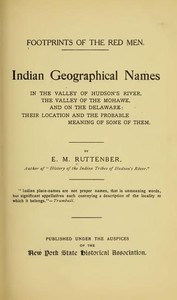
Footprints of the Red Men: Indian geographical names in the valley of Hudson's river, the valley of the Mohawk, and on the Delaware: their location and the probable meaning of some of them.
Written by Edward Manning Ruttenber
Chaptra reads alongside you — AI insights, chapter breakdowns and reader discussions for every book. Join free
About this book
Reading guide
Themes, characters and key ideas in Footprints of the Red Men: Indian geographical names in the valley of Hudson's river, the valley of the Mohawk, and on the Delaware: their location and the probable meaning of some of them., written by Chaptra AI.
- about 8 hours
- advanced
- scholarly
- informative
- reflective
Footprints of the Red Men" by Edward Manning Ruttenber is a pioneering early 20th-century work dedicated to cataloging and interpreting Indigenous geographical names across the Hudson River, Mohawk, and Delaware valleys. Ruttenber emphasizes that these names are not arbitrary labels but rather descriptive markers reflecting the landscape, history, and culture of the Indigenous peoples. The book addresses the challenges of preserving these names, including dialectal variations, inconsistent European spellings, and the gradual loss of their original meanings. Through meticulous research, Ruttenber aims to reconstruct these lost etymologies, offering a deeper understanding of the natural world and the historical context from the perspective of the original inhabitants.
“These names are not mere arbitrary labels, but descriptive markers revealing profound insights into the geography, history, and culture of the indigenous peoples.”
Key themes
- Cultural Preservation
- The central theme of the book is the urgent need to preserve the linguistic and cultural heritage of Indigenous peoples, specifically through the documentation and interpretation of their geographical names. Ruttenber views these names as vital 'footprints' of a disappearing culture.
- Linguistic Anthropology and Etymology
- The book delves into the study of language within its cultural context, specifically focusing on the etymology (origin and meaning) of Indigenous place names. Ruttenber attempts to reconstruct the original linguistic roots and descriptive intent behind each name.
- Historical Geography and Indigenous Knowledge
- Ruttenber's work implicitly explores how Indigenous peoples understood and described their environment, offering a unique perspective on the historical geography of the region. The names themselves are seen as a form of Indigenous knowledge, reflecting deep ecological and geographical understanding.
Worth discussing
How do Indigenous geographical names challenge or complement colonial historical narratives of a region?
Chapter-by-chapter breakdowns, character arcs and the full thematic analysis come with a free account.
Discussions
No one has started one yet
Questions this book opens up
No discussions yet
Be the first to start a discussion about this book!
Sign up to start the discussionReviews
No reviews yet
Be the first to review this book!