
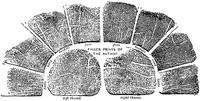
Finger Prints
Written by Francis Galton
Chaptra reads alongside you — AI insights, chapter breakdowns and reader discussions for every book. Join free
About this book
Read it with a club
Small groups reading the same books and talking as they go.


News
- 4 members
- 1,813 discussions
- Active Sep 11
Read Finger Prints alongside people who are reading it too.
Also here: News Bulletin, Just Joking....
Chaptra Prime — paid clubs, every club feature, and unlimited reading support, for $5 a month or $60 once.
See PrimeReading guide
Themes, characters and key ideas in Finger Prints, written by Chaptra AI.
- about 12 hours
- advanced
- Informative
- Analytical
- Systematic
Francis Galton's "Finger Prints" (1892) is a foundational scientific treatise that systematically explores and establishes the scientific basis for fingerprint identification. Galton meticulously categorizes and analyzes various patterns of dermal ridges, demonstrating their unique, unchanging nature across an individual's lifetime and their hereditary influences. The book provides empirical evidence and statistical analysis to prove the individuality and permanence of fingerprints, laying the groundwork for their adoption as a robust method of personal identification. It moves beyond mere observation to develop a practical classification system, thereby transforming an anecdotal curiosity into a cornerstone of forensic science.
“The patterns of the papillary ridges on the fingers are persistent throughout life, and are absolutely unchangeable.”
Key themes
- Individuality and Uniqueness
- The central theme is the scientific demonstration that each individual possesses a unique and unchanging set of fingerprint patterns. Galton meticulously provides statistical and empirical evidence to support the idea that no two individuals, not even identical twins, share the exact same fingerprints, establishing a physical basis for individual identity.
- Scientific Classification and Systematization
- Galton's work is a masterclass in scientific classification. He developed a systematic method for categorizing the complex patterns of fingerprints, transforming a chaotic collection of observations into an organized and usable system. This classification was crucial for making fingerprint identification a practical tool.
- Permanence and Persistence
- Another core theme is the demonstration of the unchanging nature of fingerprints throughout an individual's life. Galton provided compelling evidence that the patterns of dermal ridges, once formed, remain constant from infancy to old age, even after minor injuries, making them reliable for long-term identification.
Worth discussing
Discuss the scientific methodology employed by Galton in 'Finger Prints.' How rigorous was his approach for its time?
Chapter-by-chapter breakdowns, character arcs and the full thematic analysis come with a free account.
Discussions
No one has started one yet
Questions this book opens up
No discussions yet
Be the first to start a discussion about this book!
Sign up to start the discussionReviews
No reviews yet
Be the first to review this book!