
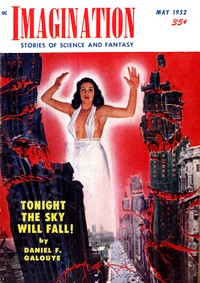
Final Examination
Written by Robert Sheckley
Chaptra reads alongside you — AI insights, chapter breakdowns and reader discussions for every book. Join free
About this book
Reading guide
Themes, characters and key ideas in Final Examination, written by Chaptra AI.
- about 8 hours
- intermediate
- mysterious
- existential
- satirical
Robert Sheckley's "Final Examination" is a thought-provoking science fiction short story from the early 1950s that plunges humanity into an existential crisis. When stars mysteriously vanish from the Milky Way, an enigmatic voice announces a five-day countdown to humanity's judgment day. The narrative follows Adam Ostersen, an ordinary man, as he navigates a world grappling with panic, bizarre theories, and the fracturing of societal norms. Amidst chaos and unexpected acts of kindness, the story observes diverse human reactions to impending doom. Ultimately, the judgment is ironically postponed for ten years, revealing a profound commentary on human nature, resilience, and the fragile balance between good and evil in the face of cosmic uncertainty.
“The stars, once the immutable anchors of the night sky, now blinked out like extinguished candles, leaving behind only deeper, more profound voids.”
Key themes
- Human Nature Under Pressure
- This theme explores the diverse and often contradictory ways individuals and societies react when faced with an imminent, inescapable threat to their existence. It highlights the spectrum of human behavior, from panic and selfishness to unexpected acts of altruism and resilience.
- Existentialism and Cosmic Indifference
- The story grapples with humanity's place in a vast, potentially indifferent universe. The concept of an external, unknowable force judging humanity underscores our insignificance and the arbitrary nature of existence, prompting questions about purpose and meaning.
- The Nature of Judgment and Morality
- The narrative directly questions what constitutes 'worthiness' for continued existence. It implicitly asks what criteria a higher power (or even humanity itself) would use to judge collective behavior, and whether a single 'examination' can truly capture the complexity of human morality. The postponement adds a layer of irony, suggesting judgment is an ongoing process.
Worth discussing
How does humanity's response to the vanishing stars and impending judgment reflect our deepest fears and desires?
Chapter-by-chapter breakdowns, character arcs and the full thematic analysis come with a free account.
Discussions
No one has started one yet
Questions this book opens up
No discussions yet
Be the first to start a discussion about this book!
Sign up to start the discussionReviews
No reviews yet
Be the first to review this book!