
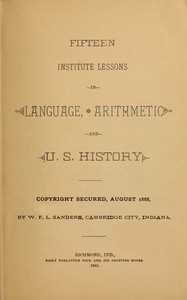
Fifteen Institute Lessons in Language, Arithmetic, and U.S. History
Written by William Francis Lewis Sanders
Chaptra reads alongside you — AI insights, chapter breakdowns and reader discussions for every book. Join free
About this book
Reading guide
Themes, characters and key ideas in Fifteen Institute Lessons in Language, Arithmetic, and U.S. History, written by Chaptra AI.
- about 8 hours
- intermediate
- informative
- structured
- didactic
William Francis Lewis Sanders's "Fifteen Institute Lessons in Language, Arithmetic, and U.S. History" is an educational textbook designed to provide foundational instruction across three core subjects. Structured as a series of fifteen progressive lessons, the work aims to equip students with essential skills in language arts, mathematical reasoning, and knowledge of American history. It reflects the pedagogical approaches and curriculum standards prevalent during its time of publication, serving as a comprehensive guide for institute-level learning. The book's primary purpose is didactic, focusing on clarity, structure, and the systematic impartation of knowledge rather than narrative storytelling or character development.
“"The diligent student understands that mastery of fundamentals is the cornerstone of all advanced learning."”
Key themes
- The Importance of Foundational Education
- This theme is central to the book's entire purpose. It emphasizes that a strong grounding in core subjects like language, arithmetic, and history is essential for individual development and societal function. The structured, progressive nature of the lessons underscores the belief that mastery of fundamentals is crucial before advancing to complex concepts. The book itself is a testament to the value placed on basic literacy, numeracy, and civic knowledge.
- American Civic Identity and Patriotism
- Particularly evident in the U.S. History sections, this theme explores how education was used to cultivate a specific sense of American identity, civic duty, and national pride. The historical narratives presented would likely emphasize key national achievements, founding principles, and the responsibilities of citizenship. It reflects the role of education in nation-building and instilling shared cultural values.
- Logical Reasoning and Precision
- This theme is most prominent in the arithmetic sections but also underlies the structured approach to language. It champions the development of clear, sequential thought processes, accuracy, and problem-solving skills. Arithmetic demands precision and logical steps, while language lessons likely emphasize grammatical rules and logical sentence construction for effective communication.
Worth discussing
How do the pedagogical methods presented in this book compare to modern educational practices?
Chapter-by-chapter breakdowns, character arcs and the full thematic analysis come with a free account.
Discussions
No one has started one yet
Questions this book opens up
No discussions yet
Be the first to start a discussion about this book!
Sign up to start the discussionReviews
No reviews yet
Be the first to review this book!