
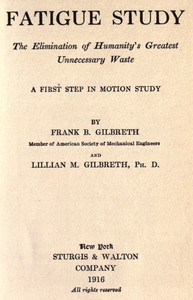
Fatigue study : $b the elimination of humanity's greatest unnecessary waste. A first step in motion study
Written by Lillian Moller Gilbreth,Frank B. (Frank Bunker) Gilbreth
Chaptra reads alongside you — AI insights, chapter breakdowns and reader discussions for every book. Join free
About this book
Reading guide
Themes, characters and key ideas in Fatigue study : $b the elimination of humanity's greatest unnecessary waste. A first step in motion study, written by Chaptra AI.
- about 8 hours
- advanced
- Informative
- Analytical
- Pioneering
Lillian and Frank Gilbreth's "Fatigue Study" is a seminal early 20th-century scientific treatise that systematically addresses fatigue in the workplace as an "unnecessary waste" hindering both productivity and worker well-being. The book advocates for an empirical, scientific approach to understanding, measuring, and ultimately eliminating industrial fatigue, presenting it as an economic and humanitarian challenge. It details methodologies, particularly linking fatigue study with their pioneering motion study techniques, to observe and analyze work processes for inefficiencies that contribute to worker exhaustion. The Gilbreths propose practical solutions and improved work conditions, establishing a framework for scientific management that prioritizes the worker's physical and mental state as integral to overall efficiency and societal progress. Through systematic observation and data-driven insights, the text aims to provide universal solutions for mitigating fatigue across various industries.
“Fatigue is humanity's greatest unnecessary waste.”
Key themes
- Fatigue as Preventable Waste
- This is the core thesis of the book. The Gilbreths fundamentally reframe fatigue from an inevitable consequence of labor to an avoidable inefficiency that incurs significant costs—both human and economic. They argue that systematic analysis and intervention can eliminate this waste, leading to improved productivity and better worker health.
- Scientific Management and Efficiency
- The book is deeply rooted in the principles of scientific management, advocating for the application of scientific methods—observation, measurement, analysis, and systematic experimentation—to optimize work processes. It extends beyond simple time-and-motion studies to include the physiological and psychological factors of the worker, aiming for maximum efficiency without detriment to the individual.
- Empirical Observation and Measurement
- A fundamental tenet of the Gilbreths' work is the insistence on data-driven decision-making. They reject anecdotal evidence or traditional practices in favor of rigorous, quantifiable observation. This theme underpins all their proposed methodologies, emphasizing that understanding and solving fatigue requires precise measurement of movements, time, and worker responses.
Worth discussing
How do the Gilbreths' definitions and methods for studying fatigue compare to modern understanding and practices in ergonomics or occupational psychology?
Chapter-by-chapter breakdowns, character arcs and the full thematic analysis come with a free account.
Discussions
No one has started one yet
Questions this book opens up
No discussions yet
Be the first to start a discussion about this book!
Sign up to start the discussionReviews
No reviews yet
Be the first to review this book!