
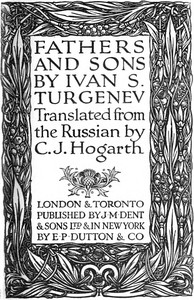
Fathers and Sons
Written by Ivan Sergeevich Turgenev
Chaptra reads alongside you — AI insights, chapter breakdowns and reader discussions for every book. Join free
About this book
Reading guide
Themes, characters and key ideas in Fathers and Sons, written by Chaptra AI.
- about 8 hours
- intermediate
- philosophical
- melancholy
- reflective
Ivan Turgenev's "Fathers and Sons" is a seminal 19th-century Russian novel that masterfully explores the profound ideological chasm between the older, aristocratic generation and the emerging radical youth. Central to the narrative is the nihilist medical student Yevgeny Bazarov, whose rejection of traditional values, art, and sentiment challenges the genteel world of the Kirsanov family, particularly the liberal-minded Nikolai Petrovitch and his aristocratic brother Pavel Petrovitch. The story unfolds as Bazarov influences Arkady Kirsanov, a recent university graduate, leading to intellectual clashes, personal transformations, and the eventual disillusionment of some characters with their rigid beliefs. Through these interactions, Turgenev examines themes of generational conflict, the nature of love, social change, and the search for meaning in a rapidly evolving society, ultimately offering a nuanced portrayal of a pivotal moment in Russian intellectual history.
“"A nihilist is a man who bows to no authority, who accepts no principle on faith, no matter how much respect that principle may be hallowed by tradition and surrounded by glory."”
Key themes
- Generational Conflict
- This is the central theme, exploring the ideological and cultural clash between the older generation (represented by the Kirsanov brothers) and the younger generation (Bazarov and Arkady). It delves into differing views on tradition, progress, art, science, and the very fabric of society.
- Nihilism vs. Traditionalism
- This theme directly pits Bazarov's radical nihilistic philosophy – a rejection of all established norms, authorities, and beliefs not based on scientific fact – against the traditional values of the Russian gentry, encompassing art, romance, social etiquette, and inherited principles.
- Love and Relationships
- The novel explores various forms of love – romantic, familial, and platonic – and how they challenge or affirm characters' ideologies. It particularly examines the complexities of love, especially for Bazarov, who initially dismisses it as a 'romantic rot' but finds himself deeply affected by it.
Worth discussing
How does Turgenev portray the 'nihilist' philosophy through Bazarov? Is he a hero, a villain, or something more complex?
Chapter-by-chapter breakdowns, character arcs and the full thematic analysis come with a free account.
Discussions
No one has started one yet
Questions this book opens up
No discussions yet
Be the first to start a discussion about this book!
Sign up to start the discussionReviews
No reviews yet
Be the first to review this book!