
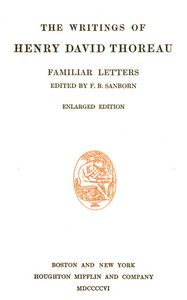
Familiar Letters: The Writings of Henry David Thoreau, Volume 06 (of 20)
Written by Henry David Thoreau
Chaptra reads alongside you — AI insights, chapter breakdowns and reader discussions for every book. Join free
About this book
Reading guide
Themes, characters and key ideas in Familiar Letters: The Writings of Henry David Thoreau, Volume 06 (of 20), written by Chaptra AI.
- about 10 hours
- advanced
- reflective
- philosophical
- intimate
Henry David Thoreau's "Familiar Letters," Volume 06, offers an intimate collection of personal correspondence from the mid-19th century, serving as a direct window into the mind of one of America's most profound thinkers. These letters chronicle Thoreau's early life and formative years in Concord, detailing his observations and experiences primarily through exchanges with family and contemporaries. The volume explores his deep connections to nature, his evolving philosophical views, and his engagement with the pressing social issues of his era. Through his characteristic wit and moral reflections, Thoreau reveals his character as a dedicated thinker, teacher, and poet, deeply intertwined with both his immediate environment and broader existential inquiries, ultimately illustrating his perspectives on individuality, freedom of thought, and humanity's relationship with the natural world.
“I went to the woods because I wished to live deliberately, to front only the essential facts of life, and see if I could not learn what it had to teach, and not, when I came to die, discover that I had not lived.”
Key themes
- The Spiritual and Philosophical Value of Nature
- Nature is not merely a setting but a living entity, a teacher, and a source of profound spiritual and philosophical insight for Thoreau. His letters are replete with detailed observations of the natural world, linking its cycles and phenomena to deeper truths about existence, human character, and the divine. He sees nature as a mirror for the soul and a realm where true freedom and clarity can be found.
- Individuality and Self-Reliance
- Thoreau consistently champions the importance of living an authentic life guided by one's own conscience and principles, rather than conforming to societal expectations. The letters reveal his personal struggles and triumphs in cultivating an independent spirit, often advocating for a simple life that prioritizes thought and experience over material wealth.
- The Pursuit of Truth and Knowledge
- Thoreau's letters reveal a relentless intellectual curiosity and a commitment to seeking truth through direct experience, observation, and critical thought. He engages with philosophical questions, often challenging conventional wisdom and advocating for a life of intentional inquiry rather than passive acceptance. This pursuit is deeply intertwined with his engagement with nature and his commitment to self-education.
Worth discussing
How do Thoreau's personal letters illuminate or challenge your understanding of his public works like *Walden* or *Civil Disobedience*?
Chapter-by-chapter breakdowns, character arcs and the full thematic analysis come with a free account.
Discussions
No one has started one yet
Questions this book opens up
No discussions yet
Be the first to start a discussion about this book!
Sign up to start the discussionReviews
No reviews yet
Be the first to review this book!