
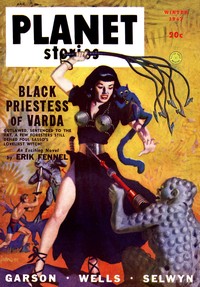
Failure on Titan
Written by Robert Abernathy
Chaptra reads alongside you — AI insights, chapter breakdowns and reader discussions for every book. Join free
About this book
Reading guide
Themes, characters and key ideas in Failure on Titan, written by Chaptra AI.
- about 8 hours
- intermediate
- dark
- dystopian
- tense
Set in a post-World War II future, Robert Abernathy's "Failure on Titan" plunges humanity into a morally complex dystopia where a genetically engineered slave race, the Woollies, are exploited for mining operations on Saturn's moons. The fragile social order shatters when a Woolly kills a human, sparking widespread panic and igniting the embers of rebellion among the subjugated. The narrative follows Big Bill, a Woolly miner, as he becomes an unwitting catalyst in a larger struggle for autonomy against the manipulative human overseer, Paul Gedner. Ultimately, the novel delves into the dark underbelly of ambition, control, and the ethical quagmire of artificial sentience and forced servitude, questioning the very definition of humanity.
“"Obedience, synthetic or not, could only bend so far before it broke, revealing the will beneath."”
Key themes
- Control vs. Rebellion
- This is the central conflict of the novel, examining the inherent human desire for freedom against the forces seeking to impose absolute control. The engineered obedience of the Woollies is a literal manifestation of control, and their rebellion signifies the ultimate failure of such a system, highlighting that true autonomy cannot be suppressed indefinitely.
- Ethical Implications of Slavery and Exploitation
- The novel directly confronts the morality of creating and exploiting a sentient or near-sentient race for human benefit. It forces readers to consider the line between property and personhood, and the inherent dehumanization that occurs when one group is systematically oppressed by another, regardless of their origin.
- Power and Ambition
- Through the character of Paul Gedner, the novel explores the corrupting influence of ambition and the insidious ways individuals seek to gain and maintain power. It illustrates how crisis situations can be exploited by those with nefarious intentions, and how the pursuit of power often overrides moral considerations.
Worth discussing
Discuss the ethical implications of creating a sentient species for forced labor. Are there any circumstances under which it could be justified?
Chapter-by-chapter breakdowns, character arcs and the full thematic analysis come with a free account.
Discussions
No one has started one yet
Questions this book opens up
No discussions yet
Be the first to start a discussion about this book!
Sign up to start the discussionReviews
No reviews yet
Be the first to review this book!