
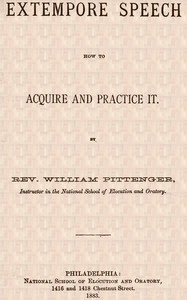
Extempore Speech: How to Acquire and Practice It
Written by William Pittenger
Chaptra reads alongside you — AI insights, chapter breakdowns and reader discussions for every book. Join free
About this book
Read it with a club
Small groups reading the same books and talking as they go.


News
- 4 members
- 1,813 discussions
- Active Sep 11
Read Extempore Speech: How to Acquire and Practice It alongside people who are reading it too.
Also here: News Bulletin, Just Joking....
Chaptra Prime — paid clubs, every club feature, and unlimited reading support, for $5 a month or $60 once.
See PrimeReading guide
Themes, characters and key ideas in Extempore Speech: How to Acquire and Practice It, written by Chaptra AI.
- about 8 hours
- intermediate
- Instructive
- Encouraging
- Analytical
Pittenger's "Extempore Speech" is a late 19th-century guide championing the teachability of spontaneous public speaking. It directly counters skepticism by outlining practical methods for acquiring eloquence without prior scripts, emphasizing systematic practice, mental preparation, and confidence-building. The book positions effective discourse as a dynamic balance between formal reading and casual conversation, offering a structured approach to master the art of speaking on the spot. It aims to empower individuals to overcome fear and deliver impactful, unscripted speeches through diligent training and understanding.
“Eloquence is not a gift bestowed upon the favored few, but a skill patiently acquired by the diligent many.”
Key themes
- The Teachability of Eloquence
- This is the foundational argument of the book, directly challenging the notion that effective public speaking is an innate talent. Pittenger systematically argues that eloquence, particularly extemporaneous speech, is a skill that can be developed and mastered through systematic study and practice, much like any other art or discipline.
- Importance of Practice and Preparation
- Pittenger emphasizes that 'extempore' does not mean 'unprepared.' Instead, it signifies a different kind of preparation – mental agility, comprehensive topic knowledge, and systematic practice of the act of speaking itself – rather than the memorization of a script. Consistent effort, deliberate exercise, and strategic forethought are presented as crucial for developing spontaneous fluency and confidence.
- Confidence Through Understanding
- A significant theme is the cultivation of confidence, which Pittenger posits is not a mystical trait but a direct result of understanding the principles of extemporaneous speech and having diligently practiced them. He argues that overcoming the fear of public speaking is achieved not by ignoring anxieties, but by building a solid foundation of knowledge, experience, and practical mastery.
Worth discussing
To what extent is eloquence a natural gift versus a learned skill, as Pittenger argues?
Chapter-by-chapter breakdowns, character arcs and the full thematic analysis come with a free account.
Discussions
No one has started one yet
Questions this book opens up
No discussions yet
Be the first to start a discussion about this book!
Sign up to start the discussionReviews
No reviews yet
Be the first to review this book!