
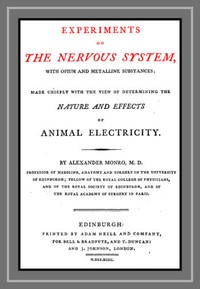
Experiments on the Nervous System with Opium and Metalline Substances: Made Chiefly with the View of Determining the Nature and Effects of Animal Electricity
Written by Alexander Monro
Chaptra reads alongside you — AI insights, chapter breakdowns and reader discussions for every book. Join free
About this book
Reading guide
Themes, characters and key ideas in Experiments on the Nervous System with Opium and Metalline Substances: Made Chiefly with the View of Determining the Nature and Effects of Animal Electricity, written by Chaptra AI.
- about 10 hours
- advanced
- Analytical
- Empirical
- Investigative
Alexander Monro's late 18th-century scientific publication, "Experiments on the Nervous System with Opium and Metalline Substances," meticulously details a series of investigations into the effects of various chemical and electrical stimuli on animal nervous systems. Primarily conducted on frogs, the experiments systematically explore the distinct responses elicited by opium, which induces paralysis and reduced muscle responsiveness, and metalline substances, which cause convulsions. Monro's work critically examines the concept of "animal electricity," a prevailing scientific idea of the era, through empirical observation. Ultimately, the treatise proposes significant distinctions between intrinsic nervous energy and external electrical phenomena, thereby making a valuable contribution to the nascent fields of physiology and neurobiology.
“The nervous power is a distinct principle from the electric fluid, though capable of being excited by it.”
Key themes
- The Nature of Animal Electricity and Nervous Energy
- This is the central theme of Monro's work, exploring the fundamental distinction and relationship between the vital force that animates the nervous system and the then-emerging concept of electricity as a physiological agent. Monro sought to determine whether nervous action was itself electrical, or if electricity merely served as a stimulus or an analogue. His experiments aimed to delineate the unique properties of each, moving beyond a simplistic equation of the two.
- Empiricism and Experimental Methodology
- Monro's work exemplifies the Enlightenment's commitment to empirical observation and systematic experimentation as the primary means of acquiring knowledge. The book is a testament to the power of careful design, execution, and documentation of experiments to test hypotheses and draw conclusions about the natural world. It showcases the scientific method in its nascent stages, emphasizing reproducible results and logical inference from observed phenomena.
- Early Neurobiology and Physiological Understanding
- The book provides a snapshot of early attempts to understand the functions of the nervous system beyond mere anatomical description. It represents a crucial step in shifting focus from static structure to dynamic function, exploring how the nervous system mediates responses to external stimuli. Monro's work contributes to the foundational knowledge that would eventually lead to the development of modern neuroscience, particularly regarding nerve impulse transmission and muscle contraction.
Worth discussing
How did Monro's experimental methodology reflect the scientific standards and limitations of the late 18th century?
Chapter-by-chapter breakdowns, character arcs and the full thematic analysis come with a free account.
Discussions
No one has started one yet
Questions this book opens up
No discussions yet
Be the first to start a discussion about this book!
Sign up to start the discussionReviews
No reviews yet
Be the first to review this book!