
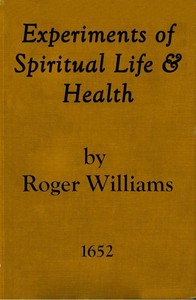
Experiments of Spiritual Life & Health, and Their Preservatives: In Which the Weakest Child of God May Get Assurance of His Spirituall Life and Blessednesse Etc.
Written by Roger Williams
Chaptra reads alongside you — AI insights, chapter breakdowns and reader discussions for every book. Join free
About this book
Reading guide
Themes, characters and key ideas in Experiments of Spiritual Life & Health, and Their Preservatives: In Which the Weakest Child of God May Get Assurance of His Spirituall Life and Blessednesse Etc., written by Chaptra AI.
- about 12 hours
- advanced
- uplifting
- reflective
- instructive
Roger Williams' "Experiments of Spiritual Life & Health, and Their Preservatives" is a profound 17th-century theological treatise offering guidance on personal piety and spiritual assurance. Originally penned as a letter to his recovering wife, the work extends its compassionate counsel to all believers, from the 'weakest child of God' to the strongest, seeking to confirm their spiritual life and blessedness. Williams systematically explores the nature of faith, the sources of doubt, and practical means to cultivate a robust spiritual health. It serves as both a pastoral guide and a devotional aid, emphasizing the intimate relationship between the individual and God amidst life's trials and spiritual struggles.
“The weakest spark of grace, if truly kindled, is a fire from heaven, never to be quenched.”
Key themes
- Spiritual Assurance
- This is the central theme, addressing how believers can gain and maintain a confident knowledge of their salvation and relationship with God. Williams explores the signs, means, and obstacles to assurance, aiming to dispel doubt and foster peace.
- Personal Piety and Devotion
- The treatise delves into the practical aspects of nurturing one's individual faith through spiritual disciplines and an internal disposition. It emphasizes introspection, self-examination, and consistent engagement with God through prayer, meditation, and scripture.
- Pastoral Compassion and Empathy
- Evident from its origin as a letter to his recovering wife, Williams's work is infused with a deep sense of empathy for those struggling spiritually. He addresses anxieties and doubts with understanding, offering comfort rather than condemnation, and seeks to gently guide rather than harshly judge.
Worth discussing
How does Williams's personal motivation (writing to his wife) influence the tone and content of this theological treatise?
Chapter-by-chapter breakdowns, character arcs and the full thematic analysis come with a free account.
Discussions
No one has started one yet
Questions this book opens up
No discussions yet
Be the first to start a discussion about this book!
Sign up to start the discussionReviews
No reviews yet
Be the first to review this book!