
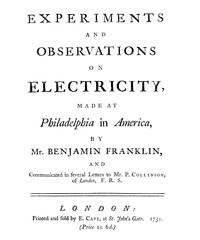
Experiments and Observations on Electricity Made at Philadelphia in America
Written by Benjamin Franklin
Chaptra reads alongside you — AI insights, chapter breakdowns and reader discussions for every book. Join free
About this book
Reading guide
Themes, characters and key ideas in Experiments and Observations on Electricity Made at Philadelphia in America, written by Chaptra AI.
- about 8 hours
- advanced
- scientific
- inquisitive
- empirical
Benjamin Franklin's "Experiments and Observations on Electricity Made at Philadelphia in America" is a seminal collection of letters and scientific papers detailing his groundbreaking investigations into electrical phenomena. Published between 1751 and 1754, this work presented a revolutionary unified theory of electricity, proposing the concept of a single electrical fluid and the terms 'positive' and 'negative' charge. Through meticulous experimentation and clear exposition, Franklin elucidated principles such as the conservation of charge and the nature of lightning, famously demonstrating the latter's electrical nature with his kite experiment. The book not only solidified Franklin's reputation as a leading scientist but also laid fundamental groundwork for the modern understanding of electricity, significantly influencing subsequent scientific inquiry and practical applications like the lightning rod.
“I was never before engaged in any study that so totally engrossed my attention and my time as this has lately done.”
Key themes
- The Nature of Electricity
- The central theme is Franklin's revolutionary exploration and definition of electricity. He challenges existing theories to propose a unified concept of a single electrical fluid, explaining phenomena through an excess (positive) or deficit (negative) of this fluid. This theme encompasses his detailed observations, experimental results, and the logical framework he constructs to explain electrical behavior.
- Empiricism and the Scientific Method
- Franklin's work is a masterclass in the application of the scientific method. He consistently emphasizes observation, systematic experimentation, logical deduction, and the formulation of hypotheses that can be tested. His writing demonstrates a commitment to evidence-based reasoning, even when it contradicted prevailing beliefs.
- Practical Application of Scientific Knowledge
- A defining characteristic of Franklin's scientific endeavors was his relentless pursuit of practical applications for his discoveries. He believed that scientific understanding should ultimately serve to improve human life and safety. This is most vividly demonstrated by his invention and promotion of the lightning rod.
Worth discussing
How does Franklin's approach to scientific inquiry reflect the broader intellectual spirit of the Enlightenment?
Chapter-by-chapter breakdowns, character arcs and the full thematic analysis come with a free account.
Discussions
No one has started one yet
Questions this book opens up
No discussions yet
Be the first to start a discussion about this book!
Sign up to start the discussionReviews
No reviews yet
Be the first to review this book!