
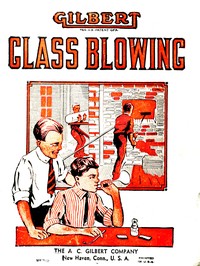
Experimental glass blowing for boys
Written by Carleton John Lynde
Chaptra reads alongside you — AI insights, chapter breakdowns and reader discussions for every book. Join free
About this book
Reading guide
Themes, characters and key ideas in Experimental glass blowing for boys, written by Chaptra AI.
- about 8 hours
- intermediate
- educational
- instructive
- curious
Carleton John Lynde's "Experimental Glass Blowing for Boys" is an early 20th-century instructional guide designed to introduce young readers, particularly boys, to the science and art of glass manipulation. Through a series of hands-on experiments, the book teaches fundamental glass blowing techniques, such as heating, bending, cutting, and shaping glass tubing. It encourages practical engagement by guiding readers to create various items, from simple balloons and siphons to more complex devices like submarines and air guns. Beyond the practical skills, the text elucidates the scientific principles at play, covering concepts like atmospheric pressure, buoyancy, and material properties, thereby fostering both scientific curiosity and an appreciation for craftsmanship.
“"The true scientist is not merely a reader of books, but an active explorer of the world around him."”
Key themes
- Scientific Inquiry and Experimentation
- The book fundamentally champions the scientific method, encouraging readers to learn through direct experimentation, observation, and analysis. It presents glass blowing not just as a craft, but as a medium for understanding physics and chemistry.
- Practical Skills and Craftsmanship
- Beyond scientific concepts, the book places significant value on developing manual dexterity, precision, and the satisfaction derived from creating functional objects. It teaches the discipline and patience required for skilled craftwork.
- Material Science and Properties
- A core theme is the exploration of glass as a material – its unique properties, how it reacts to heat, and how it can be shaped and manipulated. The book demystifies the material, transforming it from a fragile object into a versatile medium.
Worth discussing
How does Lynde's approach to science education compare to modern STEM curricula?
Chapter-by-chapter breakdowns, character arcs and the full thematic analysis come with a free account.
Discussions
No one has started one yet
Questions this book opens up
No discussions yet
Be the first to start a discussion about this book!
Sign up to start the discussionReviews
No reviews yet
Be the first to review this book!