
Chaptra
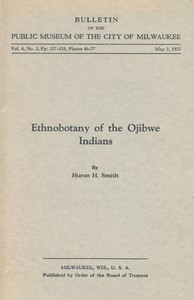
Cover of Ethnobotany of the Ojibwe Indians

Ethnobotany of the Ojibwe Indians

Written by Huron H. (Huron Herbert) Smith

Not rated yet — tap a star to review it

Chaptra reads alongside you — AI insights, chapter breakdowns and reader discussions for every book. Join free

About this book

"Ethnobotany of the Ojibwe Indians" by Huron H. Smith is a scientific publication written in the early 20th century. This work explores the use of native and introduced plants by the Ojibwe people, documenting their medicinal, dietary, and practical applications. It emphasizes the importance of traditional knowledge regarding plant use among the Ojibwe, particularly as this knowledge is at risk of being lost over time. The opening of the text introduces readers to the purpose and methodology behind Smith's ethnobotanical survey of the Ojibwe. The author notes that the fieldwork was conducted over multiple trips to various reservations in Wisconsin and Minnesota, engaging with older Ojibwe community members to gather their traditional plant knowledge. Smith reflects on the significance of this information, particularly given the decline in customary practices and the mortality of many elder informants. The narrative also delves into aspects of Ojibwe culture, illustrating how deeply intertwined their understanding of plants is with their spiritual beliefs and societal traditions.

Reading guide

Themes, characters and key ideas in Ethnobotany of the Ojibwe Indians, written by Chaptra AI.

  • about 15 hours
  • advanced
  • Informative
  • Academic
  • Preservative

Huron H. Smith's "Ethnobotany of the Ojibwe Indians" is an early 20th-century scientific publication meticulously documenting the extensive knowledge of native and introduced plants held by the Ojibwe people. The work systematically explores the medicinal, dietary, and practical applications of these plants, highlighting the intricate connection between Ojibwe culture, spirituality, and their environment. Smith's research, conducted through fieldwork on various reservations in Wisconsin and Minnesota, involved engaging with elder Ojibwe community members to preserve traditional plant knowledge at a time when it was rapidly declining. The book serves as a vital record, underscoring the urgency of documenting indigenous wisdom before it is irrevocably lost due to changing practices and the passing of knowledgeable elders. It stands as a foundational text in ethnobotany, bridging scientific inquiry with the preservation of cultural heritage.

It is with a deep sense of urgency that this work is undertaken, for the knowledge of native plant uses among the Ojibwe is rapidly fading, carried away with each passing elder.

Key themes

Preservation of Traditional Ecological Knowledge (TEK)
This is the central driving force of the entire work. Smith explicitly states his purpose is to record and preserve the Ojibwe's extensive plant knowledge, which he observed to be rapidly disappearing due to changing lifestyles and the passing of elders. The book itself is a testament to the urgency and importance of safeguarding indigenous wisdom for future generations.
Interconnectedness of Culture, Spirituality, and Environment
The book illustrates how deeply embedded plant knowledge is within the broader fabric of Ojibwe culture and spiritual beliefs. Plant uses are not merely utilitarian; they are often accompanied by rituals, stories, and a worldview that sees the natural world as animate and interconnected, emphasizing respect and reciprocity.
Ethnobotany as a Scientific Discipline and Cultural Bridge
The book itself is a foundational work in ethnobotany, demonstrating the value of combining botanical science with ethnographic methods. It acts as a bridge between Western scientific classification and indigenous knowledge systems, validating the latter through systematic documentation and analysis.

Worth discussing

Discuss the ethical considerations of ethnobotanical research, particularly when conducted by non-indigenous scholars in the early 20th century. How might such research be approached differently today?

Chapter-by-chapter breakdowns, character arcs and the full thematic analysis come with a free account.

Discussions

No one has started one yet

Join

Questions this book opens up

No discussions yet

Be the first to start a discussion about this book!

Sign up to start the discussion

Reviews

No reviews yet

Be the first to review this book!