
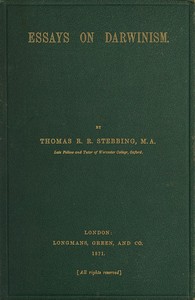
Essays on Darwinism
Written by Thomas Roscoe Rede Stebbing
Chaptra reads alongside you — AI insights, chapter breakdowns and reader discussions for every book. Join free
About this book
Reading guide
Themes, characters and key ideas in Essays on Darwinism, written by Chaptra AI.
- about 12 hours
- advanced
- scholarly
- analytical
- intellectual
Thomas Roscoe Rede Stebbing's "Essays on Darwinism" is a late 19th-century scholarly collection that meticulously examines Charles Darwin's theories of natural selection and evolution. The work aims to clarify the scientific underpinnings of Darwinism, dispel common misconceptions, and address contemporary critiques. Stebbing emphasizes the critical importance of intellectual engagement with scientific material, advocating for an open-minded exploration rather than dismissive rejection. Through a series of essays, the author connects evolutionary theory to broader philosophical questions concerning life, humanity, and the complex relationship between science and religion, setting a foundation for deep intellectual discourse.
“"Darwin's clarity and commitment to truth remains a beacon against the shadows of misunderstanding."”
Key themes
- The Nature of Scientific Inquiry and Truth
- Stebbing consistently champions the rigorous, evidence-based approach characteristic of scientific inquiry. He highlights Darwin's commitment to empirical observation and logical deduction as the pathway to understanding natural phenomena. The theme explores how scientific truth is established, defended, and refined, emphasizing the necessity of intellectual honesty and thorough engagement with evidence rather than preconception.
- Science, Religion, and Philosophy
- Stebbing delves into the profound implications of Darwinian evolution for traditional religious beliefs and broader philosophical inquiries about life, morality, and humanity's place in the cosmos. He likely seeks to bridge the perceived chasm between scientific findings and spiritual/existential concerns, suggesting that a proper understanding of evolution does not necessarily lead to nihilism but rather prompts a re-evaluation of fundamental questions. The essays explore how a scientific worldview can coexist with or inform philosophical and ethical frameworks.
- Public Understanding and Misconceptions of Science
- A central concern for Stebbing is the widespread misunderstanding and misrepresentation of Darwin's theories. He meticulously addresses common fallacies and critiques, arguing that many rejections of Darwinism stem from a lack of proper education or a refusal to genuinely engage with the scientific material. This theme underscores the challenges of communicating complex scientific ideas to a broader public and the responsibility of both scientists and the public in fostering scientific literacy.
Worth discussing
How does Stebbing's approach to defending Darwinism reflect the intellectual climate of the late 19th century?
Chapter-by-chapter breakdowns, character arcs and the full thematic analysis come with a free account.
Discussions
No one has started one yet
Questions this book opens up
No discussions yet
Be the first to start a discussion about this book!
Sign up to start the discussionReviews
No reviews yet
Be the first to review this book!