
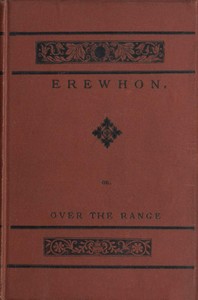
Erewhon; Or, Over the Range
Written by Samuel Butler
Chaptra reads alongside you — AI insights, chapter breakdowns and reader discussions for every book. Join free
About this book
Reading guide
Themes, characters and key ideas in Erewhon; Or, Over the Range, written by Chaptra AI.
- about 8 hours
- intermediate
- satirical
- philosophical
- witty
Samuel Butler's "Erewhon; Or, Over the Range" is a satirical novel charting the journey of an unnamed protagonist who discovers a hidden land called Erewhon, where societal norms are inverted. Through the narrator's observations of its peculiar inhabitants and their customs, Butler critically examines Victorian society, morality, and the nature of civilization itself. The narrative explores themes such as the arbitrary nature of justice, the dangers of unbridled technology, and the pervasive hypocrisy within social institutions. Ultimately, the book serves as a thought-provoking allegory, challenging readers to reconsider their own deeply held beliefs and the foundations of their culture.
“It must be remembered that we are here dealing with a people who, though very peculiar, are for the most part honest, and whose moral standard is perhaps as high as our own.”
Key themes
- Satire of Victorian Society
- The core of "Erewhon" is its biting satire of 19th-century Victorian England. Butler achieves this by creating a society that inverts many of the social, moral, and religious conventions of his time, thereby exposing their inherent absurdities, hypocrisies, and logical inconsistencies. The Erewhonian treatment of illness as a crime and crime as a disease directly lampoons Victorian attitudes towards poverty, illness, and moral failings, as well as the punitive nature of their justice system.
- The Nature of Justice and Morality
- Butler explores the arbitrary and culturally constructed nature of justice and morality. By presenting a society where health is a moral imperative and illness a punishable offense, he forces readers to question the foundations of their own ethical systems. The novel suggests that what is considered 'right' or 'wrong' is often a product of social conditioning, rather than an absolute truth, and that compassion can be misdirected or absent where it is most needed.
- Critique of Technology and Progress
- One of the most prescient themes is Butler's critique of unchecked technological advancement, particularly in 'The Book of the Machines.' This section, presented as an Erewhonian philosophical treatise, argues that machines are evolving organisms that could eventually enslave or replace humanity. This fear led the Erewhonians to destroy all advanced machinery, highlighting a profound anxiety about industrialization and the potential dehumanizing effects of progress.
Worth discussing
How does Butler's inversion of illness and crime challenge our conventional understanding of morality and justice?
Chapter-by-chapter breakdowns, character arcs and the full thematic analysis come with a free account.
Discussions
No one has started one yet
Questions this book opens up
No discussions yet
Be the first to start a discussion about this book!
Sign up to start the discussionReviews
No reviews yet
Be the first to review this book!