
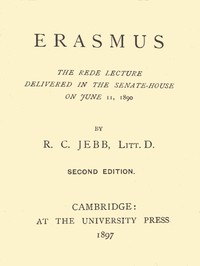
Erasmus
Written by R. C. (Richard Claverhouse) Jebb
Chaptra reads alongside you — AI insights, chapter breakdowns and reader discussions for every book. Join free
About this book
Reading guide
Themes, characters and key ideas in Erasmus, written by Chaptra AI.
- about 15 hours
- advanced
- Scholarly
- Informative
- Historical
R. C. Jebb's "Erasmus" is a late 19th-century biographical account that meticulously traces the life and intellectual journey of Desiderius Erasmus, a towering figure of the Northern Renaissance. The book illuminates Erasmus's pivotal role as a scholar, critic, and advocate for Church reform, positioning him as a crucial precursor to the Protestant Reformation. Jebb chronicles Erasmus's struggles with monastic life, his groundbreaking advancements in Greek scholarship, and his influential relationships with contemporaries like Thomas More and John Colet. Through an examination of his major works, such as the "Adagia" and "Praise of Folly," the biography reveals Erasmus's unique blend of humanistic learning, satirical wit, and profound spiritual inquiry. Ultimately, Jebb presents Erasmus as a catalyst for significant intellectual and religious shifts that reshaped European society.
“"Erasmus stood as a solitary beacon, illuminating the path of reasoned inquiry amidst the dogmatic shadows of his age."”
Key themes
- Intellectual Freedom and Scholarship
- This theme is central to Erasmus's life and Jebb's portrayal. The book highlights Erasmus's relentless pursuit of knowledge, his dedication to mastering classical languages, and his advocacy for *ad fontes* (back to the sources) in both classical and biblical studies. It explores his struggles against dogmatic scholasticism and his belief that learned scholarship was essential for both individual enlightenment and societal progress. Erasmus's intellectual independence, even in the face of pressure from church and state, is a recurring motif.
- Church Reform and Christian Humanism
- Jebb meticulously details Erasmus's role as a leading voice for reform within the Catholic Church, advocating for a more ethical, less ritualistic, and more Christ-centered faith. This theme explores Erasmus's 'Philosophy of Christ,' which emphasized inner piety, simple devotion, and moral conduct over outward ceremonies and scholastic debates. His critiques of monastic corruption, clerical ignorance, and papal abuses are thoroughly examined, positioning him as a key figure in the broader movement of Christian humanism that sought to reconcile classical learning with Christian piety.
- The Power of the Written Word and Satire
- This theme explores how Erasmus utilized the emerging power of the printing press and his mastery of language to disseminate his ideas and critiques across Europe. Jebb highlights Erasmus's exceptional literary skill, particularly his use of satire and wit in works like 'Praise of Folly,' as a powerful, yet often subtle, weapon against ignorance, corruption, and dogmatism. The biography demonstrates how Erasmus's writings shaped public opinion, influenced intellectual discourse, and prepared the ground for the more radical changes of the Reformation.
Worth discussing
How does Jebb portray Erasmus's intellectual independence, and what were the costs and benefits of this stance during the Reformation?
Chapter-by-chapter breakdowns, character arcs and the full thematic analysis come with a free account.
Discussions
No one has started one yet
Questions this book opens up
No discussions yet
Be the first to start a discussion about this book!
Sign up to start the discussionReviews
No reviews yet
Be the first to review this book!