
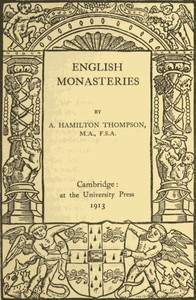
English Monasteries
Written by A. Hamilton (Alexander Hamilton) Thompson
Chaptra reads alongside you — AI insights, chapter breakdowns and reader discussions for every book. Join free
About this book
Reading guide
Themes, characters and key ideas in English Monasteries, written by Chaptra AI.
- about 8 hours
- advanced
- Informative
- Scholarly
- Historical
A. Hamilton Thompson's "English Monasteries" is an early 20th-century scholarly work offering a comprehensive historical and architectural survey of monastic life in England. The book meticulously traces the evolution of various monastic orders from their early foundations through the medieval period, detailing their organizational structures, daily routines, and spiritual codes, primarily the Rule of St. Benedict. It examines the profound cultural and architectural legacy of these institutions, highlighting their significance in the social fabric of medieval England. Thompson's work serves as an essential resource for understanding the historical context and physical manifestations of English monasticism, catering to those with an interest in medieval religious history and architectural heritage.
“(No specific quotes available without access to the full text, but typical quotes would involve definitions of monastic terms, descriptions of architectural features, or historical summaries of monastic impact. For example, a quote defining the Rule of St. Benedict or describing the typical layout of a Cistercian abbey.)”
Key themes
- The Evolution of Monasticism
- This theme traces the historical development of monastic life in England, from its earliest forms and the establishment of various orders (Benedictine, Cistercian, etc.) to their eventual decline and dissolution. Thompson meticulously documents how monastic practices and institutions adapted over centuries.
- Architectural Significance and Legacy
- Thompson extensively explores the architectural dimension of English monasteries, treating them as monumental structures that reflect artistic, engineering, and liturgical developments. This theme highlights how buildings were designed to facilitate monastic life and worship, and how their styles evolved over centuries.
- Religious Discipline and Spiritual Life
- Central to the book is an examination of the spiritual codes and daily disciplines that governed monastic life, primarily the Rule of St. Benedict. This theme delves into the routines of prayer, work, and study, and the underlying spiritual purpose of monastic existence.
Worth discussing
How did the Rule of St. Benedict fundamentally shape the character and development of English monasteries?
Chapter-by-chapter breakdowns, character arcs and the full thematic analysis come with a free account.
Discussions
No one has started one yet
Questions this book opens up
No discussions yet
Be the first to start a discussion about this book!
Sign up to start the discussionReviews
No reviews yet
Be the first to review this book!