
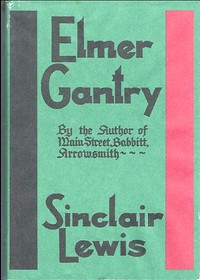
Elmer Gantry
Written by Sinclair Lewis
Chaptra reads alongside you — AI insights, chapter breakdowns and reader discussions for every book. Join free
About this book
Read it with a club
Small groups reading the same books and talking as they go.


News
- 4 members
- 1,813 discussions
- Active Sep 11
Read Elmer Gantry alongside people who are reading it too.
Also here: News Bulletin, Just Joking....
Chaptra Prime — paid clubs, every club feature, and unlimited reading support, for $5 a month or $60 once.
See PrimeReading guide
Themes, characters and key ideas in Elmer Gantry, written by Chaptra AI.
- about 15 hours
- intermediate
- satirical
- critical
- cynical
Sinclair Lewis's "Elmer Gantry" chronicles the tumultuous life of its titular character, a charismatic yet morally bankrupt individual, as he navigates the world of American evangelicalism in the early 20th century. Beginning as a boisterous, hedonistic college student, Elmer stumbles into various religious vocations, driven less by genuine faith and more by a hunger for power, adulation, and worldly pleasures. The novel serves as a scathing satire of religious hypocrisy, the commercialization of faith, and the credulity of the masses, exposing the darker underbelly of revivalist movements. Through Gantry's rise from itinerant preacher to influential pastor, Lewis dissects the corrupting influence of ambition and the often-fragile line between piety and performance, leaving readers to ponder the true nature of spirituality in a rapidly changing society.
“He was a man of God, and he was a man of the world, and he wanted to make both of them pay.”
Key themes
- Hypocrisy of Organized Religion
- This is the central theme of the novel. Lewis relentlessly exposes the chasm between the professed ideals of piety and the actual practices of many religious leaders and institutions. Through Elmer Gantry, the novel illustrates how faith can be corrupted by ambition, greed, and moral failings, turning spiritual guidance into a performance or a business venture.
- Ambition and Corruption
- The novel deeply explores how unchecked ambition can lead to moral corruption. Elmer Gantry's primary motivation is not spiritual enlightenment but personal advancement, power, and the adulation of the crowd. His drive to succeed in the religious sphere mirrors the broader American pursuit of success, albeit through morally dubious means.
- Faith vs. Doubt and Intellectual Honesty
- While Elmer Gantry embodies superficial faith, the novel also explores the profound struggle between genuine belief and intellectual doubt, primarily through the character of Frank Shallard. This theme highlights the conflict between dogmatic fundamentalism and a more reasoned, questioning approach to spirituality, examining the personal cost of intellectual honesty within rigid religious structures.
Worth discussing
To what extent is Elmer Gantry a product of his environment, and to what extent is he responsible for his own moral failings?
Chapter-by-chapter breakdowns, character arcs and the full thematic analysis come with a free account.
Discussions
No one has started one yet
Questions this book opens up
No discussions yet
Be the first to start a discussion about this book!
Sign up to start the discussionReviews
No reviews yet
Be the first to review this book!