
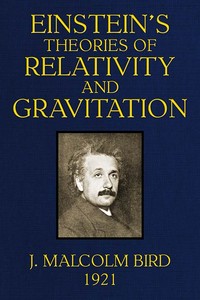
Einstein's Theories of Relativity and Gravitation: A selection of material from the essays submitted in the competition for the Eugene Higgins prize of $5,000
Written by J. Malcolm (James Malcolm) Bird
Chaptra reads alongside you — AI insights, chapter breakdowns and reader discussions for every book. Join free
About this book
Reading guide
Themes, characters and key ideas in Einstein's Theories of Relativity and Gravitation: A selection of material from the essays submitted in the competition for the Eugene Higgins prize of $5,000, written by Chaptra AI.
- about 10 hours
- intermediate
- educational
- intellectual
- challenging
J. Malcolm Bird's "Einstein's Theories of Relativity and Gravitation" is a pivotal early 20th-century work designed to demystify Albert Einstein's revolutionary concepts for the general public. As an edited compilation of essays submitted for the Eugene Higgins Prize, the book meticulously guides readers through the complexities of relativity and gravitation. Bird's introduction establishes the competition's goal of popularizing science, emphasizing the necessity of a foundational understanding before delving into the intricate theories. The volume thoughtfully arranges philosophical discussions on reality and perception, followed by a structured exploration of Einstein's ideas, making them both intriguing and accessible. It stands as a testament to the era's ambition to bridge the gap between cutting-edge science and public comprehension.
“The challenge was to explain the complex theories proposed by Einstein, namely relativity and gravitation, in a way that is comprehensible to the general reader.”
Key themes
- Popularization of Science
- This is the central driving force of the book and the prize competition. It explores the societal need and the intellectual challenge of translating complex, paradigm-shifting scientific theories into language and concepts accessible to the general public. It highlights the belief that scientific literacy is crucial for an informed citizenry.
- The Nature of Reality and Perception
- Einstein's theories fundamentally altered classical Newtonian conceptions of space, time, and gravity. This theme is explored through the book's initial philosophical discussions, which aim to prepare the reader's mind by challenging intuitive, everyday perceptions of reality before introducing the scientific models that contradict them. It delves into how science can redefine our most basic understandings of existence.
- Scientific Literacy and Education
- The book implicitly and explicitly advocates for the importance of scientific literacy. Bird emphasizes the 'necessity of preparing the reader's mind with a solid foundation of scientific knowledge.' This theme explores not just the content of science, but the *process* of learning it, the prerequisites for comprehension, and the value placed on an educated populace capable of engaging with complex scientific ideas.
Worth discussing
What were the unique challenges of popularizing Einstein's theories in the early 20th century compared to today's scientific breakthroughs?
Chapter-by-chapter breakdowns, character arcs and the full thematic analysis come with a free account.
Discussions
No one has started one yet
Questions this book opens up
No discussions yet
Be the first to start a discussion about this book!
Sign up to start the discussionReviews
No reviews yet
Be the first to review this book!