
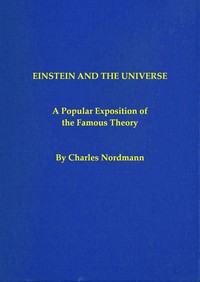
Einstein and the universe: A popular exposition of the famous theory
Written by Charles Nordmann
Chaptra reads alongside you — AI insights, chapter breakdowns and reader discussions for every book. Join free
About this book
Reading guide
Themes, characters and key ideas in Einstein and the universe: A popular exposition of the famous theory, written by Chaptra AI.
- about 8 hours
- intermediate
- informative
- intellectual
- enlightening
“Einstein and the Universe” by Charles Nordmann is a seminal early 20th-century popular exposition designed to demystify Albert Einstein's revolutionary theories, particularly relativity, for general readers. Authored by a renowned astronomer, the book aims to communicate the profound changes in our understanding of space and time with remarkable clarity and accessibility. Beginning with a commendatory preface by Viscount Haldane, the work sets a philosophical tone, portraying scientific inquiry as a romantic exploration of the cosmos. It systematically guides the reader from historical perspectives on classical physics to the groundbreaking principles of Einstein's work, promising to fundamentally reconstruct foundational knowledge of the universe. Nordmann's effort stands as a crucial early example of effectively bridging the gap between complex scientific discovery and public comprehension.
“To unravel the mysteries of the cosmos is not merely an intellectual exercise, but a romantic exploration of the highest order.”
Key themes
- The Redefinition of Space and Time
- This is the core intellectual endeavor of the book. Nordmann meticulously explains how Einstein's theories shattered the Newtonian concepts of absolute space and time, introducing instead a dynamic, interconnected spacetime where measurements are relative to the observer's motion. This theme explores the profound implications of this shift for both physics and our fundamental understanding of reality, challenging long-held intuitions about the universe.
- The Accessibility and Popularization of Science
- A foundational theme reflecting the book's very purpose. Nordmann, with Haldane's explicit endorsement, directly confronts the challenge of translating cutting-edge, mathematically intensive physics into a language comprehensible to the general reader. This theme underscores the vital importance of public scientific literacy and the crucial role of dedicated communicators in bridging the gap between specialist experts and the lay populace, ensuring that groundbreaking discoveries are widely understood and appreciated.
- Scientific Revolution and Paradigm Shift
- The book chronicles a momentous shift in scientific understanding, moving from the long-held certainties of classical physics to the revolutionary and often counter-intuitive insights of Einsteinian relativity. This theme highlights how scientific progress frequently involves overthrowing established dogmas and embracing entirely new frameworks that fundamentally alter our worldview. It emphasizes the intellectual courage, imagination, and empirical evidence required for such profound shifts in scientific paradigms, illustrating how what was once considered absolute can be re-evaluated.
Worth discussing
How does Nordmann's approach to popularizing science compare to contemporary science communicators? What are the enduring challenges?
Chapter-by-chapter breakdowns, character arcs and the full thematic analysis come with a free account.
Discussions
No one has started one yet
Questions this book opens up
No discussions yet
Be the first to start a discussion about this book!
Sign up to start the discussionReviews
No reviews yet
Be the first to review this book!