
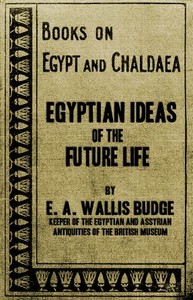
Egyptian Ideas of the Future Life
Written by E. A. Wallis (Ernest Alfred Wallis) Budge
Chaptra reads alongside you — AI insights, chapter breakdowns and reader discussions for every book. Join free
About this book
Reading guide
Themes, characters and key ideas in Egyptian Ideas of the Future Life, written by Chaptra AI.
- about 12 hours
- advanced
- informative
- scholarly
- historical
Sir E. A. Wallis Budge's "Egyptian Ideas of the Future Life" is a seminal historical account, serving as the inaugural volume in a series designed to demystify ancient Egyptian beliefs concerning resurrection and the afterlife. Written in the late 19th century, it confronts the challenge of tracing these concepts across millennia, acknowledging their evolutionary nature and the absence of a singular authoritative doctrine. The book emphasizes the pervasive influence of immortality on Egyptian culture, religious life, and burial practices. Through a comprehensive survey, particularly of the "Book of the Dead," Budge illuminates how a complex tapestry of ideas, from the sublime to the superstitious, converged to form the Egyptians' pivotal understanding of life beyond death.
“The systematic tracing of ancient Egyptian beliefs concerning the afterlife presents formidable challenges, as these ideas evolved without a singular authoritative doctrine.”
Key themes
- Immortality and the Afterlife
- This is the central and most pervasive theme, exploring the ancient Egyptian belief in life beyond death. Budge meticulously details their conceptions of the soul's various components (Ka, Ba, Akh), the perilous journey through the underworld (Duat), the judgment of the heart by Osiris, and the eventual attainment of an eternal existence in the Field of Reeds. The theme highlights how this pursuit of immortality dictated nearly all aspects of Egyptian religious, social, and cultural life.
- Evolution and Diversity of Religious Beliefs
- Budge explicitly addresses the dynamic nature of ancient Egyptian religious thought, emphasizing that beliefs about the afterlife were not static but evolved significantly over millennia, incorporating regional variations, new theological ideas, and popular superstitions. This theme counters the notion of a monolithic, unchanging Egyptian religion, showcasing its adaptability and complexity.
- The Significance of Sacred Texts (e.g., The Book of the Dead)
- This theme explores the crucial role played by ancient Egyptian funerary texts as repositories of religious knowledge, ritual instructions, and magical spells. Budge's analysis underscores how these texts were not merely descriptive but prescriptive, serving as vital tools for the deceased to navigate the dangers of the underworld and achieve eternal life. It highlights the power of written tradition in preserving and transmitting complex spiritual concepts.
Worth discussing
How did the absence of a 'singular authoritative doctrine' impact the evolution and diversity of ancient Egyptian beliefs concerning the afterlife?
Chapter-by-chapter breakdowns, character arcs and the full thematic analysis come with a free account.
Discussions
No one has started one yet
Questions this book opens up
No discussions yet
Be the first to start a discussion about this book!
Sign up to start the discussionReviews
No reviews yet
Be the first to review this book!